
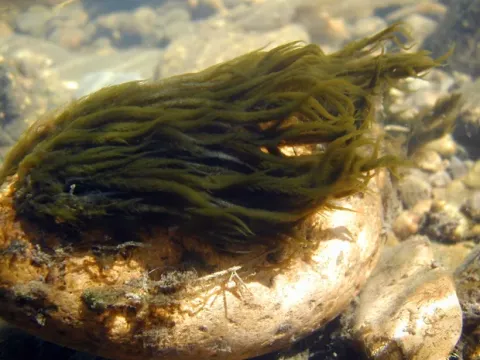
Hydrurus foetidus
Hydrurus foetidus
Hydrurus foetidus typically forms slimy, gelatinous colonies that appear as olive-green to brownish branched clusters or tufts.
What the section contains
Hydrurus foetidus
These colonies attach firmly to rocks, submerged vegetation, and the surfaces of artificial hydrotechnical structures in flowing water.
A distinctive feature of this algae is the strong, unpleasant odor released during the decomposition of its organic mass.
When colonies detach, they float as large, brown, jelly-like masses that can cover the surface of slow-moving water bodies.
Upon drying, the colonies leave behind thin, stubborn films that are difficult to remove from concrete surfaces and pipes.
Hydrurus foetidus is a member of the chrysophyte (golden-brown algae) group, which is highly adapted to cold, running water environments.
It is not a parasitic pathogen in the traditional sense but an aggressive colonizer that competes for space and aquatic resources.
The organism reproduces through both vegetative fragmentation and the production of motile zoospores that colonize new downstream areas.
Its biological resilience is enhanced by its ability to form resting cysts, allowing it to survive harsh winter conditions and seasonal environmental changes.
As a photoautotroph, it utilizes solar energy to thrive in environments where nutrient levels might be relatively low but oxygen levels are high.
This algae thrives in cold, clean, fast-flowing water, commonly found in mountain streams and high-altitude water distribution channels.
Temperatures ranging from near freezing to 10 degrees Celsius are optimal for its maximum growth rate, favoring spring and autumn periods.
Solid, stable substrates such as rocks, stones, or concrete channel linings are essential for the attachment of its gelatinous holdfasts.
High water clarity allows for deep light penetration, supporting intense photosynthetic activity and the rapid expansion of algal biomass.
An abundance of dissolved oxygen in the water is a prerequisite for the healthy development of large-scale Hydrurus populations.
The primary concern is the clogging of filtration screens, pump intakes, and irrigation water distribution lines, leading to system failure.
The excessive slime production restricts the water flow capacity of narrow pipes and canals, increasing operational costs for maintenance.
Decomposing algae releases organic matter that compromises water quality, potentially causing issues for downstream crops and agricultural livestock.
The foul-smelling gases emitted during decay create environmental nuisances in areas surrounding water processing or distribution facilities.
The proliferation of this algae disrupts natural aquatic ecosystems by outcompeting native periphyton and altering the local biological balance.
Regular mechanical removal of the algal biomass is the most direct and effective way to maintain water flow in affected channels.
Optimizing the flow velocity in irrigation canals can prevent the initial attachment of zoospores, effectively inhibiting colonization.
In closed water systems, UV-C treatment has shown promise in reducing the viability of algal spores and preventing colony formation.
Managing nutrient influx and shading the water surface can help limit the growth rate and overall biomass production of the species.
Early season monitoring and preventative cleaning of infrastructure are essential to manage the rapid expansion of Hydrurus foetidus.