
Hygrocybe citrina
Hygrocybe citrina
Description
Symptoms
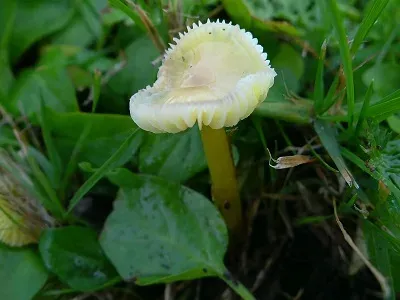
Hygrocybe citrina is a small agaric mushroom belonging to the Hygrophoraceae family, notable for its bright lemon-yellow or yellow coloration.
The cap typically measures between 1 and 4 centimeters in diameter, evolving from convex in youth to flat or slightly depressed as the fungus matures.
Its surface is generally smooth and exhibits a waxy or viscid texture when moist, which serves as a key diagnostic feature for the genus.
The gills are distant, broad, and adnate or decurrent, maintaining a color consistent with or lighter than the cap itself.
The stipe is cylindrical, hollow, fragile, and smooth, sharing the characteristic yellow hue of the cap and gills.
Pathogen
It is important to clarify that Hygrocybe citrina is not a plant pathogen. It is a saprotrophic fungus that thrives in soil or leaf litter.
This organism does not cause diseases in agricultural or ornamental crops, as it does not parasitize living plant tissues or root systems.
The life cycle of this fungus focuses on the decomposition of organic matter and plant debris in the upper soil horizons.
Its biological contribution lies in supporting nutrient cycling and maintaining biodiversity within natural ecosystems.
From an agronomic perspective, the fungus is an ecologically neutral soil-dwelling organism that poses no threat to farming operations.
Conditions for development
The primary habitat of this species includes semi-natural grasslands, pastures, and lawns that have not been subjected to intensive chemical input.
The fungus prefers areas with lower vegetation density where the soil is well-warmed and maintains moderate moisture levels.
Active fruiting typically occurs in late summer and autumn, coinciding with favorable temperature ranges and adequate rainfall.
The absence of excessive mineral fertilization is a critical environmental factor that supports the growth of its mycelial network.
The mycelium of Hygrocybe citrina is highly sensitive to chemical pollution, making it a reliable bio-indicator of healthy, unpolluted environments.
Why it matters
In agricultural practice, Hygrocybe citrina causes no harm to crop yields and does not result in economic losses for producers.
The fungus does not infect roots, stems, or leaves of cultivated plants, so no control measures are required within agricultural production.
The lack of pathogenicity is confirmed by its ecological niche: it acts as a decomposer of dead organic matter rather than a parasite.
Sometimes, inexperienced observers might mistake the growth of various mushrooms on lawns for a symptom of turf disease, which is incorrect.
Therefore, this object is not classified as a pest or harmful organism and requires no monitoring within the framework of plant protection.
Protection
Since Hygrocybe citrina is not a causative agent of plant disease, no specific control measures or chemical treatments are needed.
If manual removal from ornamental lawns is desired, picking the fruiting bodies is sufficient and has no impact on the health of the surrounding vegetation.
Maintaining plant health should rely on standard agronomic practices that remain independent of efforts to eliminate this harmless saprotroph.
It is recommended to monitor soil nutrient balances, as high nitrogen levels often suppress the development of natural grassland fungi.
Overall, the presence of this fungus indicates a balanced biological turnover within the soil ecosystem of the managed area.
Discussion
No discussions yet — be the first.