
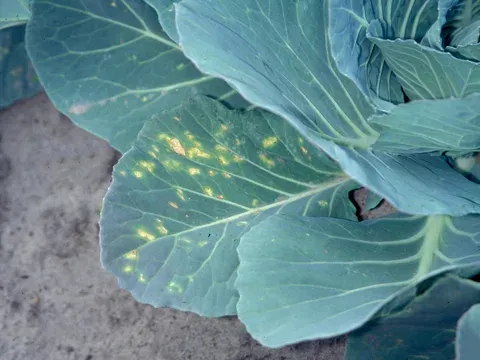
Downy mildew of crucifers
Hyaloperonospora
The disease is caused by the oomycete Hyaloperonospora brassicae, an obligate parasite that specifically infects plants in the Brassicaceae family.
What the section contains
Downy mildew of crucifers
The pathogen survives in the form of resting oospores located in the soil and on crop residues, which can remain viable for several years.
During the growing season, the pathogen spreads through asexual spores called conidia, which are easily disseminated by wind, rain splashes, and irrigation equipment.
The infection process starts when conidia germinate on the leaf surface in the presence of free moisture, forming hyphae that penetrate the host tissue.
The parasite extracts nutrients from the plant host using specialized structures called haustoria, which penetrate the host's cells without killing them immediately.
Initial symptoms appear as yellow or chlorotic spots on the upper surface of the leaves, often limited by leaf veins, giving them an angular shape.
A distinctive white to greyish-white fungal growth appears on the underside of the leaves, corresponding to the area of the upper leaf spots.
As the disease progresses, these spots turn brown or necrotic, leading to leaf tissue death and eventual premature shedding of foliage.
Seedlings infected with the pathogen often show stunted growth, distorted cotyledons, and darkened stems, which may lead to damping-off.
When floral parts are infected, they can become deformed, discolored, and covered in mold, significantly reducing seed production quality.
High humidity levels, typically exceeding 80% relative humidity, are necessary for the development and rapid spread of the disease.
Cool to moderate temperatures, generally ranging from 15°C to 20°C, are considered optimal for the sporulation and infection cycles of the oomycete.
Poor ventilation within dense crop canopies creates an ideal microclimate where moisture persists on leaf surfaces for extended periods.
Frequent rain events, heavy morning dews, and fog provide the necessary free water that enables conidia to germinate and penetrate plant tissues.
Insufficient solar radiation and shaded conditions can weaken the plants' natural defense mechanisms, making them more susceptible to attack.
The disease significantly reduces the photosynthetic area of leaves, resulting in reduced biomass accumulation and overall crop yield suppression.
For oilseed rape, severe infection leads to lower seed weight and reduced oil content, directly impacting the profitability of the harvest.
In cabbage crops, head development is often retarded, and necrotic tissue provides an entry point for secondary bacterial soft rot infections.
Significant early-season infections can lead to poor plant stand density, often requiring replanting and increasing production costs.
The overall impact includes economic losses due to decreased crop quality, reduced marketability of produce, and the cost of necessary fungicide interventions.
Crop rotation with non-host species remains the most effective cultural practice to reduce the pressure of inoculum in the soil.
Deep plowing or incorporating crop debris immediately after harvest helps to bury and decompose infected residues, limiting future infection cycles.
Using certified, disease-free seed and applying appropriate seed treatments can prevent the introduction of the pathogen into new fields.
Application of fungicides, such as metalaxyl or strobilurins, during the early stages of disease appearance can help manage outbreaks in commercial fields.
- Maintain appropriate plant spacing to improve air circulation.
- Control wild cruciferous weeds that serve as alternative hosts.
- Select resistant or tolerant varieties of cabbage and rape.