
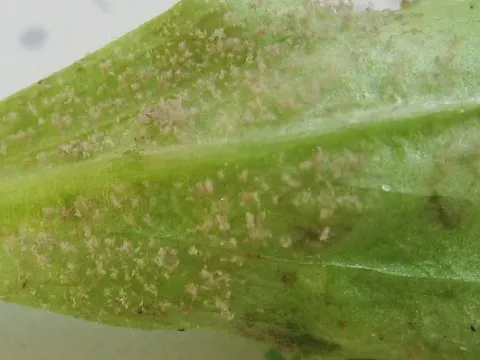
Downy mildew of corn salad
Peronospora valerianellae
The initial signs of the disease appear as chlorotic, yellowish spots on the upper side of the corn salad leaves, often visible on cotyledons and true leaves.
What the section contains
Downy mildew of corn salad
On the underside of the leaves, a distinct grayish-violet or white fungal growth develops, which is the sporulation of the pathogen.
As the infection progresses, the affected tissue turns necrotic and brown, leading to leaf deformation, curling, and eventually premature plant death.
In high humidity environments, the symptoms spread rapidly, covering the entire leaf rosette, which makes the product completely unmarketable.
Stunted growth is commonly observed in infected plants, as the pathogen severely disrupts the plant's metabolic and photosynthetic processes.
The disease is caused by the oomycete Peronospora valerianellae, an obligate parasite that specifically attacks members of the Valerianella genus.
The pathogen reproduces via zoospores, which are easily disseminated by wind, rain splashes, or irrigation water across the field.
It survives as oospores in the soil or on infected plant debris, remaining dormant until favorable conditions for germination appear.
As an obligate parasite, Peronospora valerianellae depends entirely on the living tissues of its host to complete its lifecycle.
The pathogen is known for its short incubation period, which allows it to cause rapid epidemics under optimal moisture and temperature conditions.
The development of downy mildew is primarily favored by cool to moderate temperatures ranging from 12°C to 18°C.
Persistent high humidity and free moisture on leaf surfaces, such as dew, fog, or prolonged rainfall, are essential for spore germination and infection.
Densely planted crops that lack proper air circulation create a localized microclimate that significantly accelerates the spread of the pathogen.
Overhead irrigation, especially when performed late in the day, keeps foliage wet for too long and facilitates the rapid spread of the disease.
Poor crop rotation practices result in an increased buildup of the fungal inoculum in the soil, raising the risk of infection in subsequent seasons.
The primary damage is the loss of commercial quality, as consumers and retailers have zero tolerance for leaf spots or fungal growth on salad greens.
The reduction in leaf surface area caused by necrosis leads to significant yield losses and decreases the nutritional value of the harvest.
Infected leaves are highly susceptible to secondary bacterial decay, which can ruin entire batches during storage and transport.
Economic losses are compounded by the costs of chemical interventions and potential rejection of the entire harvest by quality control inspectors.
Severe infestations can lead to total crop failure, requiring the destruction of the planting and a complete replanting of the field.
The use of resistant cultivars is the most effective long-term strategy for managing downy mildew in corn salad production.
Maintain optimal plant spacing to promote better airflow and reduce the humidity levels within the crop canopy.
Utilize drip irrigation systems to deliver water directly to the root zone, keeping the foliage dry and minimizing spore germination conditions.
Apply registered fungicides as a preventive measure or at the very first sign of infection to curb further spread within the field.
- Implement a strict crop rotation cycle of at least 3-4 years.
- Sanitize the field by removing and destroying all crop residues immediately after harvest.
- Ensure that seeds are sourced from reliable suppliers and are properly treated against seed-borne pathogens.