
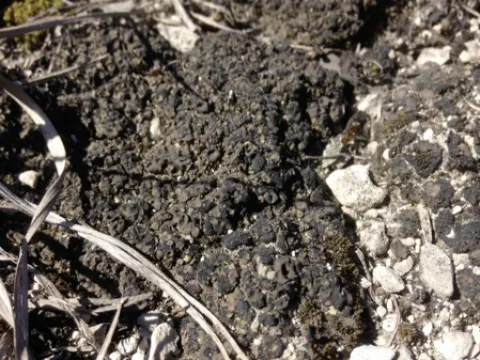
Heppia adglutinata
Heppia adglutinata
Heppia adglutinata is a species of crustose lichen belonging to the Heppiaceae family. Biologically, it is a symbiotic organism consisting of fungal mycelium and cyanobacteria (blue-green algae), adapted to colonizing soil surfaces.
What the section contains
Heppia adglutinata
While not a traditional plant pathogen that infects crop tissues, it is frequently categorized as an undesirable component in agricultural lands due to its formation of dense biogenic soil crusts.
Morphologically, it exists as a squamulose thallus that adheres tightly to the substrate. It is highly resilient to harsh, arid environments, entering a state of dormancy during dry periods to survive.
The organism relies on photosynthesis performed by its cyanobacterial partner, meaning it requires sufficient light exposure to survive and grow effectively.
Propagation occurs primarily through vegetative fragmentation, where small pieces of the thallus are dispersed by wind or water to initiate new colonies on barren soil patches.
The primary visual sign is the emergence of dark olive-green or brownish patches on the soil surface, which can develop into large, continuous crusts over time.
During humid conditions, the lichen squamules become more prominent and exhibit a vibrant green color, whereas in dry conditions, they appear shriveled and dark.
A distinctive trait is its firm adhesion to the soil particles; the lichen is physically "glued" to the surface, making it difficult to remove without mechanical intervention.
Areas colonized by this lichen typically exhibit reduced porosity and a distinct crusty surface texture, which is a major indicator of its presence.
There are no symptoms of infection on crop plants themselves, such as leaf lesions or wilting, which confirms that the issue is restricted to the soil-plant interface.
Heppia adglutinata thrives in open, sunny areas with minimal plant competition and infrequent mechanical soil disturbance.
The primary driver for its spread is the absence of tillage; frequent cultivation disrupts its growth cycle and prevents the formation of a stable thallus.
It prefers arid and semi-arid climates, often inhabiting soils with neutral to alkaline pH levels where competitive vegetation struggles to establish a dense canopy.
The organism is well-adapted to environments with intermittent moisture, utilizing short wet periods to expand and long dry periods to remain dormant.
Saline or degraded soils with low organic matter content provide an ideal niche for this lichen, as it is highly tolerant to mineral stress.
The main harm caused by this lichen is the creation of a physical surface barrier, which impairs the emergence of small-seeded crops and restricts root aeration.
The resulting crust impedes water infiltration, leading to increased runoff and moisture loss, which is particularly detrimental in drought-prone agricultural regions.
By covering the soil surface, the lichen can compete for space with emerging seedlings and may physically inhibit the growth of less competitive plant species.
Massive colonization of this species can act as a bio-indicator of poor soil management, low fertility, and a lack of consistent agricultural disturbance.
While it does not parasitize crops directly, it adversely affects the soil micro-environment, making conditions less favorable for rapid crop establishment.
The most effective management strategy is regular mechanical tillage, including plowing and harrowing, which breaks the lichen crust and prevents colony stabilization.
Maintaining high crop density helps to provide shade, which is a natural and highly effective method for suppressing light-dependent lichen colonization.
Improving overall soil fertility through organic amendments can help native or crop vegetation outcompete the lichen by improving soil structure and nutrient levels.
Implementing proper crop rotation ensures that fields are not left fallow for extended periods, reducing the time available for the lichen to establish.
In cases of severe infestation, mechanical disruption of the topsoil layer during the active growing season of the lichen is recommended to effectively eradicate the colonies.