
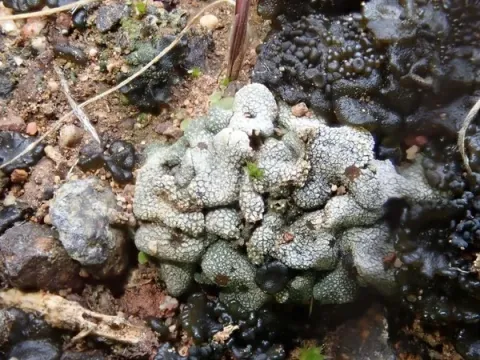
Heppiaceae lichens
Heppiaceae
Heppiaceae lichens appear as distinct, crust-like or squamulose growth formations on the bark of tree trunks and branches.
What the section contains
Heppiaceae lichens
They often manifest as small patches or scaly clusters that vary in color from greenish-brown to grey depending on humidity levels.
Unlike parasitic fungi, these growths anchor themselves superficially to the outer layers of the bark without penetrating deep into the sapwood.
The affected bark areas can become rough, and in cases of dense colonization, the bark may appear thickened or structurally altered.
They are frequently observed on older, mature trees that have accumulated layers of dead corky tissue on their surface.
This organism is not a disease in the sense of a pathogen, but a lichenized fungus belonging to the family Heppiaceae.
It is a symbiotic entity consisting of fungal mycelium and photobionts (algae), surviving primarily through atmospheric moisture and mineral dust.
It does not feed on the tree’s internal fluids, functioning instead as an epiphyte that utilizes the bark solely for physical support.
Its biological cycle is strictly regulated by environmental conditions such as light, air quality, and the moisture capacity of the substrate.
Reproduction occurs via spores carried by wind and rain, which take root in bark fissures to form new symbiotic colonies.
The primary driver for the development of these lichens is high air humidity and poor ventilation within the tree canopy.
They thrive in shaded or neglected garden environments where the bark remains damp for extended periods following rain or morning dew.
High concentrations of dead, rough bark provide an optimal surface for spore attachment and subsequent expansion of the lichen colony.
Dense orchard spacing that limits airflow creates a favorable microclimate, leading to increased lichen coverage on the trunks.
Environmental stability and lack of cleaning practices are the main reasons for the persistent presence of Heppiaceae on orchard trees.
While lichens are not directly parasitic, their dense growth provides an ideal shelter for overwintering pests such as scale insects and mites.
Excessive colonization can impede the natural gas exchange of the bark, potentially stressing the tree if the coverage is widespread.
The moisture retained by the lichen layer may create conditions suitable for secondary opportunistic fungal or bacterial infections.
The presence of significant lichen growth is a diagnostic indicator that the tree is in a weakened or neglected physiological state.
Although the lichen itself doesn't kill the tree, it complicates tree management by masking the early signs of actual bark pathogens.
The most effective approach is mechanical removal, which involves carefully scrubbing the bark with wire brushes or scrapers to dislodge the colonies.
Proper pruning techniques to thin the canopy are essential for increasing sunlight exposure and improving air circulation around the trunk.
Applying a lime wash to trunks during the dormant season alters the bark surface pH, making it hostile to lichen spore germination.
Chemical treatments using iron sulfate or copper-based fungicides can be used during the dormant phase to eradicate established colonies.
- Mechanical bark cleaning.
- Regular canopy pruning.
- Spring and autumn lime whitewashing.
- Dormant season fungicide application.