
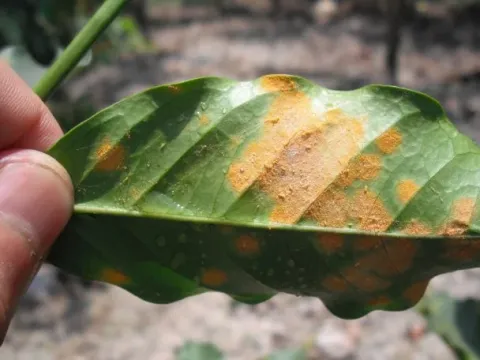
Coffee leaf rust
Hemileia vastatrix
The causative agent of coffee leaf rust is the basidiomycete fungus Hemileia vastatrix. It is an obligate parasite that specifically infects Coffea species, posing a major threat to global coffee production.
What the section contains
Coffee leaf rust
The pathogen reproduces through urediniospores, which are easily dispersed by wind and splashing rain. Once the spores land on a coffee leaf, they germinate under humid conditions and infect the host through the stomata.
After penetration, the fungus colonizes the leaf's intercellular spaces, forming a mycelial network that extracts essential nutrients from the host cells, leading to severe physiological stress.
The fungus is characterized by significant genetic diversity, with numerous races known to exist worldwide. This variability complicates the development of resistant coffee varieties as the pathogen continuously evolves.
The disease persists throughout the year in tropical coffee-growing regions, where host plants remain evergreen, ensuring a continuous supply of susceptible tissue for the fungus.
The primary symptom of coffee leaf rust is the appearance of small, yellow spots on the undersurface of the leaves. These spots gradually enlarge and become covered with a powdery, bright orange or rust-colored mass of spores.
On the upper side of the leaf, corresponding areas turn chlorotic (yellowish) and eventually develop into dark brown necrotic lesions as the tissue dies.
As the infection progresses, leaves drop prematurely, leading to severe defoliation. This process strips the tree of its photosynthetic capacity, weakening it significantly.
In advanced stages of infection, twigs may die back due to the tree's inability to maintain its metabolic functions, leading to poor fruit development and potential tree death.
Regular visual inspection of the lower canopy is critical, as the initial infection often starts there due to higher humidity levels and less direct sunlight.
High relative humidity and the presence of leaf moisture, such as dew or rain, are the most critical factors for the germination of Hemileia vastatrix spores.
The optimal temperature range for the development and spread of the fungus is between 21 and 25 degrees Celsius. Extreme temperatures outside this range significantly limit the pathogen's growth.
Plantation density is a major factor in disease severity. Overcrowded coffee plants restrict airflow and keep the foliage wet for longer periods, providing the perfect microclimate for the fungus to thrive.
Rainy seasons typically correlate with higher rates of spore production and dissemination, leading to increased disease pressure across the plantation.
Poor management of shade trees and a lack of proper pruning can create stagnant, humid environments within the plantation, which greatly facilitate the rapid spread of the rust.
Coffee leaf rust is considered the most destructive disease of coffee, capable of causing yield losses of up to 50% or more. The reduction in yield is caused by defoliation and the tree's inability to support coffee cherry development.
Beyond quantity, the quality of the harvested beans is often severely compromised, as the tree lacks the energy reserves to fill the beans properly, leading to lower-grade coffee.
The long-term impact involves the exhaustion of the tree's energy reserves, which can lead to "dieback." This often forces farmers to invest in costly rehabilitation or replanting of entire plots.
The economic burden includes the high cost of fungicides and the labor required for repeated applications, significantly increasing the cost of production for farmers.
On a macro scale, severe outbreaks of rust have historically forced regions to switch from growing high-quality Arabica to more resistant but often lower-quality coffee varieties.
Proper pruning is the primary cultural control method. It improves airflow throughout the canopy, speeds up drying of leaves, and makes the environment less hospitable to the fungus.
Chemical control usually involves the timely application of copper-based fungicides. In severe cases, systemic triazole fungicides may be used to suppress established infections.
Breeding and planting resistant coffee varieties are the most sustainable long-term strategies. Introducing genetic resistance into commercial lines reduces reliance on chemical inputs.
Balanced fertilization, especially maintaining adequate potassium levels, helps the plant maintain vigor and improves its natural resilience against fungal stress.
Sanitation practices, such as clearing debris and removing heavily infected branches, can help reduce the amount of inoculum available for future infection cycles within the plantation.