
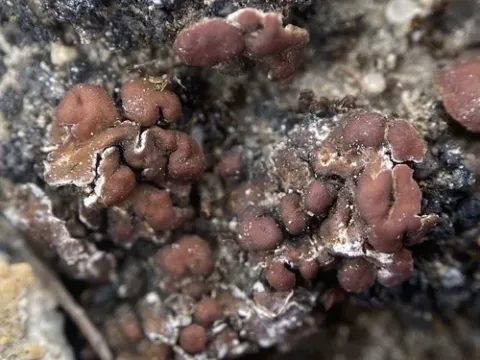
Gypsoplaca macrophylla
Gypsoplaca macrophylla
It is crucial to clarify that Gypsoplaca macrophylla is not a plant disease or a pathogen. It is a ground-dwelling lichen species belonging to the family Psoraceae.
What the section contains
Gypsoplaca macrophylla
This organism is a symbiotic association consisting of a fungal partner and photosynthetic algae. It does not parasitize vascular plants and does not secrete any toxins that could negatively affect crop health.
The confusion regarding its status often arises from its physical appearance as a crust-forming organism, which can be mistakenly identified as a symptom of a fungal infection on the soil surface.
The thallus (body of the lichen) is composed of large, distinct, or flattened scales. Its appearance changes significantly depending on hydration, shifting from olive-brown to a vibrant greenish hue.
Biologically, it is an autotrophic organism that thrives independently. It does not rely on host plants for nutrients, making it a harmless component of the soil ecosystem rather than a plant disease.
Gypsoplaca macrophylla favors open, well-lit, and arid environments. It is specifically adapted to gypsum-rich soils, which is reflected in its scientific name.
Moisture is obtained primarily from atmospheric sources such as dew and precipitation. During periods of drought, the lichen enters a dormant metabolic state to survive.
This species is typical of arid and semi-arid zones. It cannot survive in environments with dense vegetation cover because it requires direct sunlight for photosynthesis and cannot compete with taller plants.
Reproduction and dispersal occur through fungal spores or the fragmentation of the thallus, which can be transported by wind or water flow into unoccupied soil patches.
In conventional agriculture, this lichen is rarely observed. Mechanical soil cultivation, such as plowing and tilling, effectively destroys its fragile structure, preventing it from establishing in active fields.
Gypsoplaca macrophylla causes no harm to agricultural crops. It is not an agent of fungal, bacterial, or viral diseases, and it poses no threat to harvest yields.
The ecological role of this lichen is mainly related to soil stabilization. It contributes to the formation of biological soil crusts, which help prevent erosion in semi-arid areas.
The lichen does not compete with crops for soil nutrients, as it obtains minerals primarily from atmospheric dust and gases, maintaining its independent biological cycle.
No symptoms of parasitic damage, such as wilting, chlorosis, or necrosis, have ever been associated with this organism, as it lacks the physiological mechanisms to interact with crop tissues.
Its presence on a field is an indicator of minimal soil disturbance over an extended period, rather than a symptom of a pathological problem requiring intervention.
Since this lichen is not a plant disease, no protection measures or control programs are required. The use of fungicides to manage lichen populations is ineffective and ecologically unjustified.
The most effective method for controlling ground-dwelling lichens is routine mechanical soil cultivation. Plowing, harrowing, and regular weeding will physically disrupt and eliminate the lichen colonies.
Improving soil fertility through balanced fertilization encourages vigorous crop growth, which naturally shades the soil surface and creates an unsuitable environment for light-dependent lichens.
There are no quarantine or phytosanitary restrictions associated with this species, as it is a natural component of arid landscapes rather than an invasive pathogen.
Adherence to standard agronomic practices for crop management is sufficient to prevent the colonization of fields by this or other similar lichen species.