
Gyrodon lividus
Gyrodon lividus
Description
Symptoms
Visible signs of the fungus appear only during the fruiting season, when characteristic fruit bodies emerge near or around the trunks of alder trees.
The cap is typically ochre-yellow to brown, and the surface often feels viscid or slimy, especially in humid conditions, which serves as an important diagnostic feature.
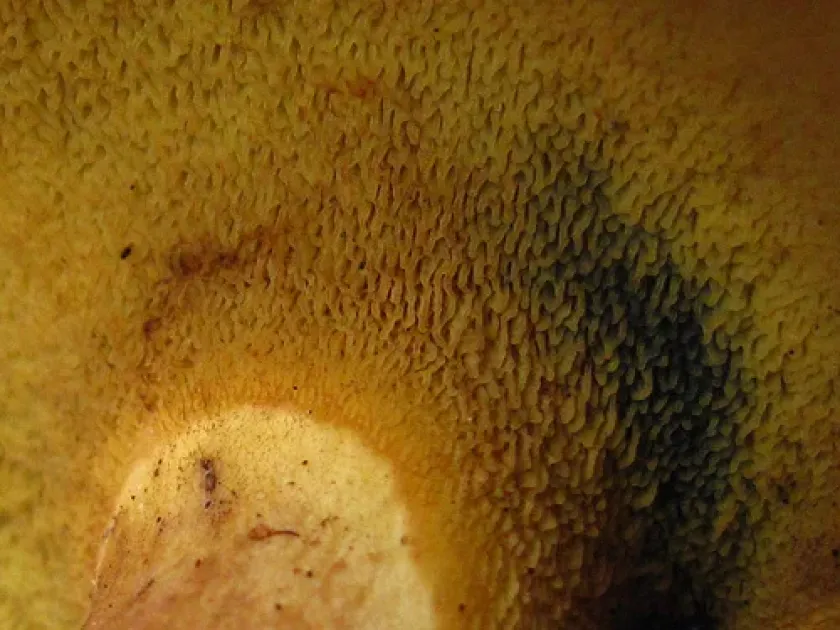
The underside of the cap is covered with tubes. In young specimens, these are yellow, while in mature ones, they turn olive-yellow or greenish.
The most distinctive identification feature is the pronounced blue staining of the flesh and the tubular layer when pressed, cut, or otherwise mechanically damaged.
- Cap shape: convex or cushion-shaped.
- Stipe: central or eccentric, usually colored similarly to the cap.
- Odor: mild, mushroom-like, non-distinctive.
Pathogen
Gyrodon lividus is not a plant pathogen in agricultural terms; it does not cause diseases in crops. Instead, it is a specialized mycorrhizal fungus belonging to the Gyrodontaceae family.
Biologically, this species is strictly associated with alder trees (Alnus). It forms a mutualistic symbiotic relationship known as mycorrhiza, which assists the tree in absorbing minerals and water from the soil.
The fungus grows in the soil around the tree's root system. Its mycelium network connects with the alder roots, facilitating an exchange of nutrients between the soil environment and the host tree.
Morphologically, Gyrodon lividus is characterized by a tubular hymenophore that rapidly turns blue when bruised or damaged, which is a key identifying trait for this specific fungus.
As an obligate symbiont, this species relies entirely on the presence of living alder roots to survive and reproduce in its natural habitat.
Conditions for development
The development of the fungus is strictly confined to ecological niches where alder grows. It is most commonly found in alder forests, riverbanks, and floodplains.
Optimal conditions for fruiting occur during summer and autumn when temperatures are mild and soil moisture levels are sufficient to support metabolic activity.
The fungus prefers waterlogged or swampy soils where alder thrives and develops an extensive root system, providing the necessary environment for the fungus.
Temperature requirements for fruiting are moderate; extreme heat or prolonged freezing temperatures inhibit the growth of the mycelium in the upper soil layers.
A high content of organic matter in the soil and a specific microbial community associated with alder roots are critical factors for the successful existence of this species.
Why it matters
Gyrodon lividus does not cause any harm to trees or plants. On the contrary, mycorrhizal fungi are essential for the overall biological stability and health of alder stands.
In industrial agriculture, this organism is not considered a pest, as it has no capability to infect or damage any commercial agricultural crops.
The lack of harm to other plants is due to the species' high degree of specialization: it has evolved solely to interact with alder and lacks the mechanisms to attack other plant root systems.
From an ecological standpoint, the fungus plays a beneficial role by participating in nutrient cycling and supporting the health of the tree's root system, thereby aiding in soil stability.
Consequently, no phytosanitary protection measures against this fungus are required in any forestry or agricultural management practice.
Discussion
No discussions yet — be the first.