
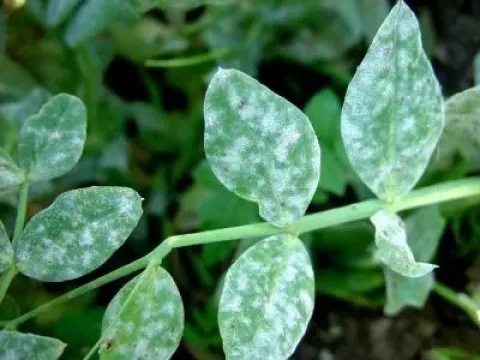
Powdery mildew
Erysiphe
The primary sign of the disease is the appearance of white, web-like spots that eventually develop into a powdery coating. This growth is most commonly found on the upper surface of leaves, but it can quickly spread to stems, petioles, and developing fruits.
What the section contains
Powdery mildew
Over time, the fungal growth turns gray or brown as the pathogen forms fruiting bodies called cleistothecia. Infected leaves become curled, yellowed, and may wither prematurely, leading to a significant reduction in the plant's photosynthetic efficiency.
In many plant species, chlorotic spots appear beneath the fungal mycelium. Heavy infections often lead to stunted growth, flower abortion, and the failure of fruit to set, significantly affecting total output.
Fruit quality is also severely compromised, with common symptoms including corky skin textures or discolored patches. Under high humidity, small droplets may form within the mycelium, resembling morning dew, which gives the disease its common name.
As the infection progresses, necrotic patches develop, causing tissue death and systemic weakness. This makes the host plant highly susceptible to other environmental stressors and secondary bacterial or fungal invaders.
Powdery mildew is caused by obligate biotrophic fungi belonging to the Erysiphales order, particularly the genus Erysiphe. These fungi derive their nutrients exclusively from living host tissue by inserting specialized structures called haustoria.
The fungus maintains an ectophytic lifestyle, primarily developing its vegetative mycelium on the surface of the plant epidermis. Only the haustoria penetrate the cell walls to extract carbohydrates and other essential nutrients from the host.
Reproduction is primarily asexual, characterized by the mass production of conidia. These spores are easily dispersed by wind, allowing for rapid colonization of healthy tissues and neighboring plants within a field or greenhouse.
Overwintering occurs primarily through the formation of cleistothecia, which remain on plant debris or in the soil. In spring, these structures release ascospores, initiating a new infection cycle when environmental conditions become suitable.
The fungus displays a high degree of host specificity, with different physiological races of Erysiphe adapted to parasitize specific crop groups, ranging from cereals and vegetables to various woody ornamentals.
The development of powdery mildew is highly dependent on warm temperatures, typically between 18°C and 25°C. Moderate to high humidity is required for the germination of spores, though the fungus can thrive even when the leaf surface is dry.
Fluctuating temperatures and the presence of dew create an ideal microclimate for the fungus to spread. Consequently, areas with poor airflow, such as dense plant canopies or crowded greenhouse environments, are most vulnerable to outbreaks.
Excessive nitrogen fertilization encourages the growth of soft, succulent plant tissues, which are significantly easier for the fungus to colonize. Conversely, a balanced nutrient profile, particularly adequate potassium, helps maintain the integrity of plant cell walls.
High-density planting prevents efficient ventilation, trapping moisture and creating a stable environment for fungal growth. Furthermore, the presence of susceptible weeds provides a reservoir for the pathogen during the off-season.
Wind is the primary vector for long-distance dispersal of conidia. Once the first signs of the disease are present in a field, the spores can spread across vast areas in a matter of days under favorable weather conditions.
The most significant impact of powdery mildew is the reduction of the plant's photosynthetic area. By covering leaves and stems, the fungus disrupts the plant's ability to produce energy, leading to overall stunted development.
Crop yields suffer substantial losses, both in quantity and quality. Cereals may exhibit shriveled grains, while fruit crops may show reduced sugar content, poor coloration, and diminished shelf life, rendering them unfit for commercial markets.
Severe infections weaken the plant's systemic resistance, often causing flower drop and fruit deformation. In cases of extreme outbreaks, the economic value of the harvest can be reduced by more than 50% due to poor marketability.
The disruption of water regulation in infected tissues makes the plant highly sensitive to drought stress. The combination of nutrient depletion and compromised water uptake can lead to premature senescence and death of the plant.
Beyond direct yield loss, the infection necessitates expensive and repetitive chemical control measures, which increase the overall production cost and potentially lead to the development of fungicide resistance in the pathogen population.
Effective management begins with the use of resistant crop varieties, which offer the most sustainable protection against Erysiphe. Integrated management practices aim to disrupt the infection cycle through strategic agronomy.
Crop rotation and the thorough removal of plant residues are essential to reduce the primary inoculum load. Maintaining proper plant spacing and ensuring good airflow within the canopy can make the environment unfavorable for the fungus.
When environmental conditions favor the disease, targeted fungicide applications—such as triazoles or strobilurins—are necessary. These chemicals effectively inhibit fungal metabolism and stop the progression of the disease.
Sulfur-based products are widely used, particularly in organic farming, because they provide a cost-effective and contact-based method for disrupting the cellular respiration of the fungus.
- Cultivating powdery mildew resistant varieties
- Implementing balanced fertilization programs
- Timely application of systemic and contact fungicides
- Sanitation through the removal of infected debris
- Optimizing canopy density for better airflow