

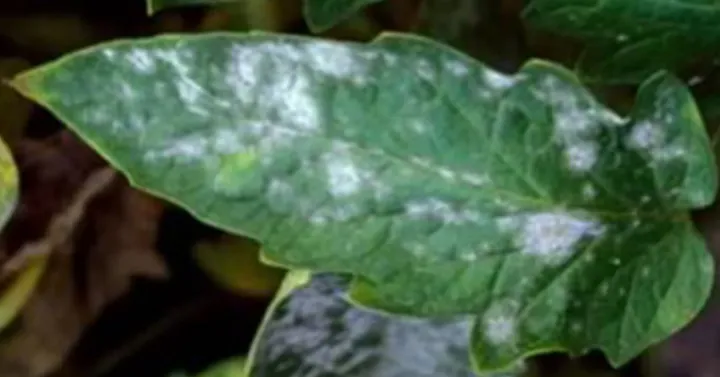
Description
Symptoms
Initial symptoms include chlorotic spots on the upper leaf surface, which gradually turn yellow and necrotic. Unlike surface-dwelling mildews, this pathogen rarely forms heavy white mats on the upper leaf side in the early stages.
A fine, whitish, powdery-like growth of conidiophores may become visible on the underside of the leaves in the areas corresponding to the chlorotic spots as the infection progresses.
As the disease advances, affected leaves dry out and fall off prematurely. This often starts at the base of the plant and moves upward, causing severe defoliation of the lower and middle foliage.
The reduced leaf area leads to poor fruit development and sunburn on exposed fruits. Yield losses are significant, and in severe cases, the entire plant can become stunted and unproductive.
- Chlorotic yellow spots on leaves
- Sparse fungal growth on the underside
- Premature leaf necrosis and shedding
- Reduced fruit quality and size
Pathogen
The causal agent is the endophytic fungus Leveillula taurica (anamorph Oidiopsis taurica). Unlike typical powdery mildews, this pathogen develops its mycelium primarily inside the host plant tissues, with only the conidiophores emerging through the stomata.
The fungus has a wide host range, infecting various crops including tomatoes, peppers, eggplants, onions, and several legumes. It is considered a major threat to horticultural production in arid and semi-arid climates globally.
Infection spreads mainly through airborne conidia, which are highly mobile and can travel long distances. The fungus survives unfavorable conditions as dormant mycelium in plant debris or on alternative weed hosts.
The biology of L. taurica is uniquely adapted to dry, warm environments, which distinguishes it from other common powdery mildew species that typically require higher humidity for colonization.
Because the fungus is endophytic, the early stages of the disease are often invisible, making it a "hidden" threat that can suddenly cause significant damage once visible symptoms appear.
Conditions for development
Leveillula taurica thrives in temperatures ranging from 20°C to 30°C. Unlike many other powdery mildews, it is highly persistent even under relatively low relative humidity conditions, making it problematic in dry summer climates.
In greenhouse settings, poor ventilation and high nocturnal humidity are primary drivers for spore germination and colonization. Stagnant air allows the humidity to accumulate within the canopy, fostering fungal growth.
Overcrowded plantings reduce light penetration and air movement, creating a stable microclimate that is ideal for the rapid spread of the pathogen between adjacent plants.
Plants under physiological stress—due to drought, nutrient deficiency, or poor soil structure—are significantly more susceptible to infection compared to vigorous, well-maintained crops.
Successive cropping cycles in greenhouses without proper breaks or sanitation provide a continuous supply of host tissue, allowing the pathogen to reach epidemic levels quickly.
Why it matters
The primary damage is caused by the substantial loss of the photosynthetic leaf area. This reduction in energy production directly correlates with lower yields and smaller fruit sizes.
Because the fungus targets the leaves, the fruit becomes exposed to intense sunlight, leading to sunburn and quality loss. This makes the harvest less marketable and unsuitable for commercial standards.
Plants infected with Leveillula are often weakened, making them susceptible to secondary pests like spider mites or other opportunistic fungal pathogens that further deplete plant vitality.
The economic cost is driven by the need for frequent fungicide applications and the potential for complete yield failure in highly susceptible greenhouse varieties.
The difficulty in early diagnosis often leads to late-stage interventions, which are less effective, thus increasing the overall management costs for agricultural producers.
Protection
Sanitation is the cornerstone of control. Removing and properly disposing of all crop debris is critical to eliminating the primary inoculum sources for the next growing season.
Cultural practices such as maintaining proper plant spacing, ensuring adequate ventilation, and choosing resistant cultivars are effective preventative measures for long-term management.
Chemical control involves the use of systemic fungicides, particularly those containing triazoles or strobilurins. Rotation of chemical classes is essential to delay or prevent the development of fungicide resistance.
Biological control agents, including Bacillus subtilis and certain mycoparasitic fungi like Ampelomyces quisqualis, can be used to suppress pathogen development in integrated pest management programs.
Regular scouting is vital for early detection. Monitoring fields or greenhouses allows for spot treatments that can prevent the spread of the fungus throughout the entire production area.
Content graph
Connections · Powdery mildew (Leveillula)
Most often together:
Marketplace
Products · 1
Community
Discussion
No discussions yet — be the first.