
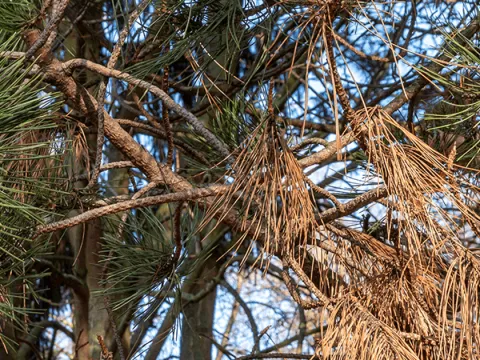
Diplodia canker
Diplodia mutila
The causative agent of this disease is the fungus Diplodia mutila (a member of the Botryosphaeriaceae family). It is a well-known pathogen capable of infecting a wide range of woody hosts, causing canker and dieback symptoms.
What the section contains
Diplodia canker
The pathogen reproduces via pycnidia, small black fruiting bodies that erupt through the bark surface. These structures release conidia, which are disseminated by wind, rain splashes, and insect vectors throughout the growing season.
Once the spores land on susceptible host tissue, they germinate and penetrate through wounds or natural openings. The fungus colonizes the vascular cambium and xylem, interfering with water transport and nutrient supply.
The fungus exists as an endophyte in many trees, meaning it can live within the plant tissue without causing immediate symptoms. Stress factors often trigger the shift from this latent state to an aggressive, pathogenic phase.
Its ability to survive in dead woody debris allows Diplodia mutila to persist in the environment for years, making the control of the primary inoculum source a critical component of disease management.
The first external signs of Diplodia canker are sunken, discolored areas on the bark of branches or main stems. These cankers gradually enlarge and may become cracked or oozing over time.
Tiny, black, pimple-like pycnidia appear within the dead bark, which is a definitive sign of the pathogen's presence. These structures distinguish this disease from other similar necrotic infections in trees.
Branch dieback is a classic symptom; the foliage on an infected branch will wilt, change color to yellow or brown, and eventually drop off prematurely. This often occurs suddenly during hot, dry weather.
On fruits, the disease causes a firm, dark rot that typically starts at the peduncle. The fruit eventually mummifies, turning into a hard, blackened structure that remains attached to the branch.
In conifers, the infection often leads to shoot blight and tip dieback. Needles turn yellow or reddish-brown, and significant resin flow may be observed around the infection sites on the main branches.
High temperatures and humidity provide the optimal environment for Diplodia mutila infection and disease progression. Spore production and release are most active during warm, wet weather conditions.
Plants under environmental stress, such as drought, flooding, or soil compaction, are significantly more susceptible to infection. Stress disrupts the tree's internal defense mechanisms against endophyte colonization.
Mechanical injuries, including pruning wounds, hail damage, or bark cracks caused by sunscald or frost, are primary entry points for the pathogen. Fresh wounds are especially vulnerable to colonization.
Crowded plantings with poor air circulation create high-humidity microclimates near the tree bark, facilitating spore germination and rapid spread of the disease between adjacent trees.
The use of unsterilized pruning tools is a major contributor to the dissemination of the fungus within an orchard or forest plantation, as spores are easily transferred on blades.
The primary damage caused by Diplodia canker is the progressive dieback of branches and potential death of the entire tree. This leads to a substantial decline in orchard productivity and quality.
Severe infections can render a tree structurally unsound, increasing the risk of branch breakage during high winds. This poses a danger to both surrounding plants and property in home gardens.
Economic losses arise from the loss of harvest due to fruit decay and the cost of removing and replacing infected trees. In the nursery trade, the presence of the pathogen leads to trade restrictions and stock losses.
The chronic nature of the disease means that infected trees serve as continuous sources of inoculum. Without management, the disease can spread through an entire orchard within a few years.
Additionally, the aesthetic value of ornamental trees is severely compromised by the presence of unsightly cankers and sparse, dying foliage, leading to high maintenance costs for landscaping.
Disease management focuses on sanitation and minimizing tree stress. Pruning out and destroying all infected, dead, or dying branches is essential to reduce the inoculum level in the environment.
All pruning cuts should be performed during dry weather to minimize the risk of spore transmission. Tools must be thoroughly disinfected with ethanol or a bleach solution between every single tree to prevent cross-contamination.
- Maintaining optimal irrigation and fertilization to keep trees vigorous and stress-free.
- Immediate treatment of all bark wounds and frost cracks with copper-based protectants.
- Removal and burning of all prunings and fallen debris to destroy the pathogen's reservoir.
- Strategic spacing of new trees to ensure adequate light penetration and air movement.
- Use of certified, disease-free nursery stock for new planting projects.
Chemical control, including copper fungicides, can be used as a preventative measure during the bud-break stage, but it is not effective as a stand-alone cure for already infected trees.