
Dictyophora
Dictyophora
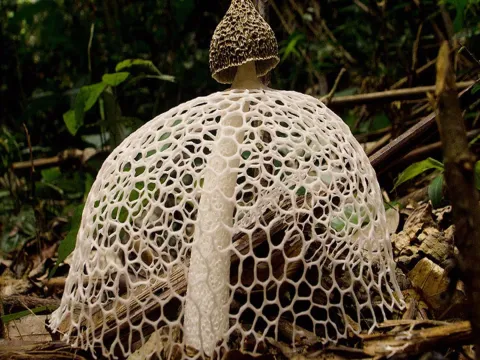
Dictyophora (genus name) is a group of fungi in the Phallaceae family, commonly referred to as the bridal veil stinkhorns due to their distinctive morphology.
What the section contains
Dictyophora
These organisms function as saprotrophs, meaning they obtain nutrients by decomposing dead organic matter rather than attacking living plant tissues.
The biological structure of the fungus is defined by its ability to produce a rapid-growing fruiting body from a subterranean network of white mycelial strands.
Unlike pathogenic fungi that cause disease, Dictyophora serves an ecological role as a decomposer, breaking down complex organic compounds into simpler forms.
Its lifecycle is highly dependent on environmental triggers, leading to the sudden appearance of the fruiting body, often referred to as a mushroom, under suitable conditions.
The appearance of Dictyophora typically begins with an underground white egg-like structure, which serves as the dormant stage before maturation.
Once conditions are right, the fungus develops a hollow, spongy stem and a cap covered in a dark, spore-bearing gleba that emits a pungent odor.
The most iconic feature is the indusium, a delicate, net-like veil that hangs down from beneath the cap, covering most of the stem surface.
The strong scent released by the cap is a primary indicator of activity, designed to attract carrion-visiting insects that facilitate the dispersal of spores.
In the soil, the presence of these fungi is marked by thick, white rhizomorphs, which are essential for nutrient transport during the growth phase.
Dictyophora thrives in environments with high humidity and consistent moisture levels, frequently appearing after significant rainfall events.
The preferred habitat includes shaded areas such as deep woodlands, moist gardens, and landscapes with abundant leaf litter or wood mulch.
Temperature plays a vital role, with moderate warmth required to stimulate the rapid expansion of the fruiting body during the peak growing season.
Good soil aeration, combined with a rich supply of decaying plant material, provides the necessary substrate for the fungal mycelium to flourish.
Light intensity is generally low in preferred habitats, as the fungus is adapted to growing under dense canopy cover where moisture is easily retained.
Dictyophora is not a plant pathogen and does not cause infections, root rots, or any form of damage to agricultural or ornamental plant species.
It maintains a healthy symbiotic or neutral relationship with the environment, acting purely as a contributor to organic matter decomposition.
There is no economic or agricultural threat posed by this fungus, as it does not compete with living crops for nutrients or physical space.
Growers and gardeners may mistake its presence for a disease, but this is a purely observational error that does not impact crop health.
The only minor concern is the odor, which might be undesirable in highly populated areas, but this is a temporary and natural phenomenon.
No chemical control measures are necessary for Dictyophora, as it is a beneficial part of the natural decomposer community in the soil.
To reduce its presence in landscaped areas, one should manage soil moisture and promote airflow to create conditions less favorable for rapid growth.
Removing the accumulation of dense organic mulch or decaying wood can limit the substrate availability for the fungal colony to establish itself.
Mechanical removal of the egg-stage fruiting bodies is sufficient for those wishing to prevent the maturation and spore dispersal of the fungi.
The application of fungicides is strongly discouraged as it is both ecologically harmful and ineffective against these non-pathogenic soil saprotrophs.