
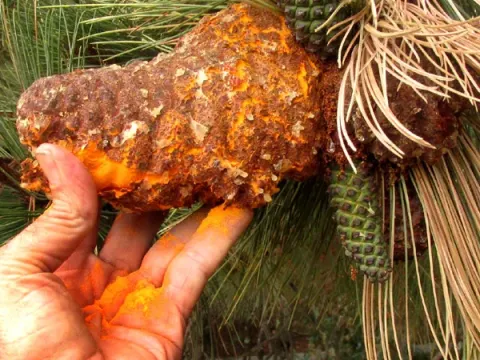
Pine cone rust
Cronartium conigenum
The disease is caused by a heteroecious rust fungus known as Cronartium conigenum. This pathogen requires two distinct hosts to complete its complex biological life cycle: certain pine species and oak trees (Quercus).
What the section contains
Pine cone rust
The fungus belongs to the Basidiomycota phylum. It produces several types of spores throughout its development, which are essential for its survival and dispersal across different forest landscapes.
The mycelium of the fungus colonizes the internal tissues of the pine tree, specifically targeting the developing cones. By doing so, it intercepts nutrients meant for seed development.
Unlike other rusts that target needles or stems, this species is specialized. It induces physiological changes that transform the normal morphology of the cone into a hypertrophic, malformed structure.
The pathogen's ability to survive in a dormant state within the host tissues allows it to persist for multiple years. This makes long-term management of the disease particularly challenging for foresters.
The most distinctive symptom of pine cone rust is the extreme deformation and enlargement of young cones. They often become hard, woody, and twisted, making them easily distinguishable from healthy ones.
During the sporulation stage, bright orange or yellow aecia emerge on the surface of the infected cones. These spore masses appear as a dusty layer that disperses easily in the wind.
The interior of the cone is often completely destroyed by the fungus, replaced by a dense mat of mycelium. Consequently, the tree fails to produce viable seeds, leading to total reproductive failure.
Infected cones may drop prematurely, or they may remain on the tree for an extended period, acting as a continued source of inoculum for surrounding susceptible hosts.
- Hypertrophic growth of cones.
- Presence of orange-yellow spore masses.
- Loss of seed production capabilities.
- Premature cone drop or malformation.
High humidity and moderate temperatures during the spring are the primary drivers of fungal infection. These conditions facilitate spore germination and entry into the vulnerable tissues of young cones.
The proximity of oak trees is critical for the disease cycle. As a heteroecious fungus, Cronartium conigenum must alternate between pine and oak hosts to survive and reproduce effectively.
Densely planted forests with poor airflow provide an ideal microclimate for the fungus. Increased moisture levels within the canopy layers significantly enhance the rate of infection spreading.
Trees under stress, whether due to drought, poor nutrition, or insect infestations, exhibit reduced immunity. Such plants are generally more susceptible to successful colonization by the pathogen.
Wind acts as the primary vector for spore dispersal. Long-distance transport of spores can cause new infection outbreaks far away from the original source of the disease.
The primary economic impact is the loss of seed production. For nurseries and seed orchards, this leads to a severe shortage of genetically valuable seeds required for reforestation efforts.
The fungus diverts energy from the tree's growth processes to support the abnormal development of infected cones. Over time, this leads to a measurable decrease in overall tree vigor and growth rate.
The inability to naturally regenerate forest stands due to seed sterility creates long-term environmental consequences. It threatens the sustainability of pine ecosystems in affected areas.
Once established in a forest, the disease can spread rapidly, becoming endemic. This necessitates costly management interventions to maintain the health and productivity of the remaining trees.
The cumulative damage to reproductive success makes pine cone rust a significant concern for silviculture and forest management planning across native ranges.
The most effective preventive strategy is to maintain spatial isolation between pine plantations and oak stands. Breaking the proximity between alternate hosts significantly reduces infection risk.
Sanitation practices, such as the systematic removal and destruction of infected cones, are essential in nursery settings. This lowers the local spore load and limits further spread.
Fungicide applications may be utilized in high-value seed orchards. Treatments must be timed precisely with the environmental conditions that favor spore release and infection periods.
Genetic improvement programs aimed at selecting resistant pine genotypes are vital. Breeding for resistance provides a sustainable, long-term solution to managing the impacts of the fungus.
Continuous monitoring of forest stands allows for early detection of the disease. Quick response measures can contain local outbreaks before they reach epidemic levels in the population.