
Pine heart rot
Porodaedalea pini
Description
Symptoms
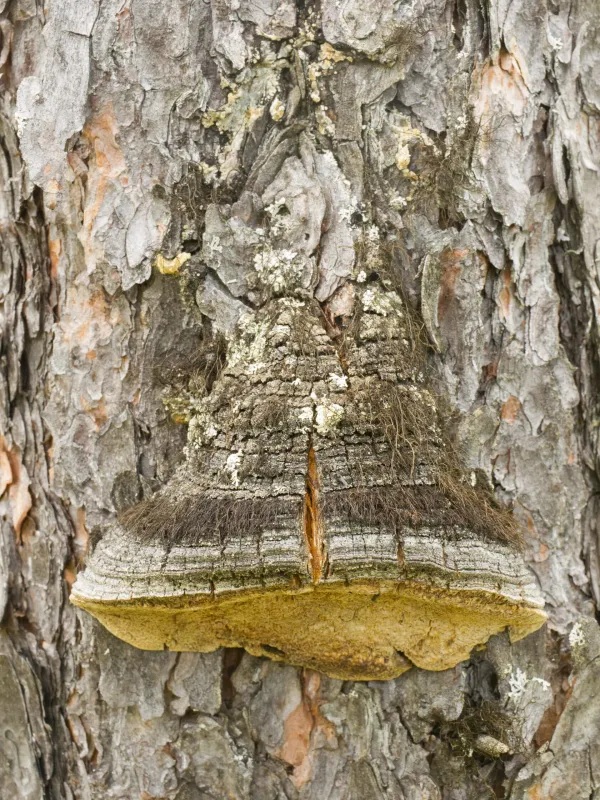
The most reliable sign of infection is the presence of perennial conks (fruiting bodies) growing on the trunk, typically at the site of old, broken branch stubs.
On early stages of decay, the heartwood shows red-brown discoloration, which later develops into more pronounced rot with white flecks or pockets of mycelium.
As the disease progresses, the decayed wood becomes brittle and tends to crack in both longitudinal and transverse directions.
Crown symptoms often include thinning foliage, reduced annual growth, and in severe cases, top-dieback, reflecting the internal stress of the tree.
Tapping the trunk may reveal a dull sound, indicating the presence of internal rot pockets where the heartwood has been completely degraded.
Pathogen
The pine heart rot is caused by the wood-decay fungus Porodaedalea pini (formerly known as Phellinus pini), which belongs to the Basidiomycota division. This pathogen is a major cause of central red-brown heart rot in conifers.
It primarily attacks coniferous trees such as Scots pine, spruce, fir, and larch. The fungus enters the heartwood through injuries on the bark, broken branches, or frost cracks.
The mycelium grows within the heartwood, progressively decomposing cellulose and lignin. Over years, this process turns solid wood into a crumbly, decayed mass, compromising the tree's structural integrity.
The fruiting bodies of this fungus are perennial, woody, and hoof-shaped. The upper surface is typically dark brown or black, often marked with concentric ridges and grooves.
Basidiospores are released from the fruiting bodies and dispersed by air currents, landing on fresh wounds of healthy trees to initiate new infections.
Conditions for development
The fungus is most prevalent in mature stands, generally infecting trees that are 40 to 50 years old or older, as these trees have sufficient heartwood for colonization.
Environmental conditions favoring infection include high atmospheric humidity, which is essential for the germination of spores on exposed wooden surfaces.
Tree stress caused by drought, poor soil conditions, or high stand density makes trees more susceptible to pathogen entry and rapid spread of the mycelium.
Mechanical injuries resulting from logging operations or wildlife damage create direct pathways for fungal spores to reach the inner heartwood.
A closed canopy and lack of proper forest hygiene in dense stands provide a microclimate that supports long-term survival and circulation of the fungal spores.
Why it matters
Pine heart rot causes significant economic losses by drastically reducing the volume of high-quality sawtimber available for commercial harvest.
The internal decay makes trees highly susceptible to windthrow and breakage during severe weather, resulting in the loss of entire tree stands.
The quality of wood is degraded, often forcing it to be classified as low-value pulpwood or firewood rather than premium structural timber.
The pathogen contributes to the decline of forest health, altering habitat structures and potentially reducing biodiversity in coniferous ecosystems.
Management costs are increased due to the need for continuous forest pathology monitoring and the labor-intensive removal of infected individuals.
Protection
The primary control measure involves the systematic removal of infected trees through selective or salvage logging to reduce the inoculum source.
Logging practices must prioritize the protection of the remaining stand to prevent mechanical injuries that serve as entry points for the fungus.
Maintaining optimal stand density and promoting vigorous tree growth through appropriate silvicultural techniques can enhance the resilience of the forest.
Regular forest health monitoring programs are essential to detect early outbreaks and isolate infected trees before the rot spreads further.
Proper disposal or utilization of infested logging debris is necessary to limit the production and dispersal of spores within the forest environment.
Discussion
No discussions yet — be the first.