
Pine needle blight
Meloderma desmazieri
Description
Symptoms
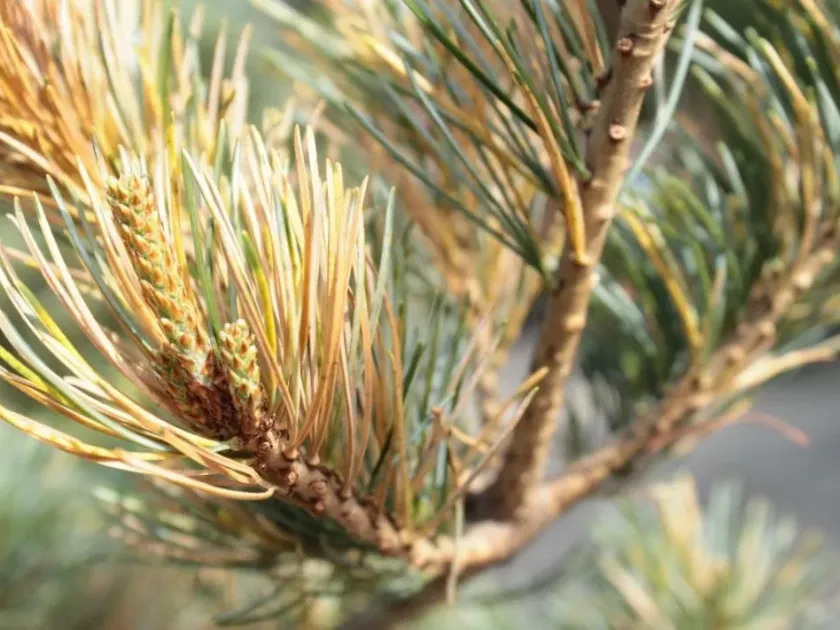
Early symptoms appear as yellow or brownish spots on the needles. As the disease progresses, these spots expand, leading to the browning of the entire needle, which gives the tree a scorched appearance.
A distinctive sign of this disease is the presence of black, elongated, shiny fruiting bodies that appear on the surface of the infected needles, both on the tree and on the ground.
Infected needles tend to shed prematurely, especially during wet summer periods, leading to sparse and thin crowns in affected pine trees.
The lower part of the crown is usually the most heavily infested, as the microclimate near the ground is typically more humid and favorable for fungal growth.
Severe infestations can lead to massive needle drop, significantly altering the tree's silhouette and causing visible stress to the entire specimen.
Pathogen
The disease is caused by the fungus Meloderma desmazieri, which is a common pathogen attacking the needles of various pine species. It belongs to the group of fungi that cause needle cast, characterized by premature shedding of foliage.
The fungus completes its life cycle primarily on fallen, infected needles. During spring and early summer, the fruiting bodies (apothecia) mature and release spores, which are disseminated by wind to healthy needles.
Once the spores land on a healthy needle, they germinate and penetrate the tissue through the stomata. The fungal mycelium then spreads within the needle, gradually causing cell death and structural decay.
This pathogen prefers high humidity and moderate temperatures, which are essential for the development of its reproductive structures.
Although it is often confused with other needle-cast fungi, Meloderma desmazieri has specific characteristics in its fruiting bodies that distinguish it from similar species in forest pathology.
Conditions for development
The development of pine needle blight is heavily dependent on weather conditions. Periods of prolonged rainfall and high humidity are the primary drivers for spore germination.
Plantations with high density or poor air circulation are particularly prone to outbreaks, as they trap moisture and create a perfect environment for fungal propagation.
Trees that are already under stress due to poor soil quality, drought, or insect infestation are significantly more susceptible to being colonized by the pathogen.
Warm spring weather combined with moisture facilitates the rapid maturation of the fungus on last year's needles, acting as a catalyst for new infections.
Environmental factors, including soil acidity and proximity to other infected hosts, play a significant role in the spread of the disease across forest areas.
Why it matters
The primary impact of the disease is the loss of photosynthetic area, which directly reduces the tree's ability to produce energy and slows down its annual growth rate.
In forestry, heavy infection can lead to the death of young seedlings in nurseries, causing significant financial losses and impacting reforestation efforts.
Weakened trees become highly vulnerable to secondary attacks by bark beetles and other wood-boring insects, which can eventually kill the tree.
From an aesthetic perspective, the disease significantly detracts from the beauty of ornamental pine trees in parks and residential gardens.
Chronic infestation weakens the tree's natural defense systems, making it less resilient to other environmental stresses such as severe winters or extreme heat waves.
Protection
Effective management begins with strict sanitation practices. Removing and burning infected needles on the forest floor helps significantly reduce the primary spore source.
Improving the health of the plantation through thinning is essential to provide better air circulation and reduce humidity levels within the canopy.
In nurseries or high-value landscapes, applying fungicides (especially copper-based products) during the spore release period can effectively prevent new infections.
- Maintaining optimal tree spacing to prevent humidity buildup.
- Using balanced fertilizers to boost tree immunity.
- Monitoring trees closely during the spring and early summer months.
In addition to chemical interventions, biological control agents can be utilized to suppress the fungal population, offering an environmentally friendly alternative for forest management.
Discussion
No discussions yet — be the first.