
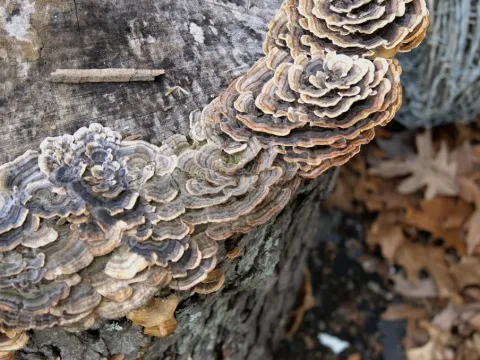
Coriolaceae fungi
Coriolaceae
The causative agents of this disease are wood-decaying fungi belonging to the Coriolaceae family. These are obligate xylotrophs that primarily affect dead, but often also living, weakened wood of both deciduous and coniferous trees.
What the section contains
Coriolaceae fungi
The fungal mycelium actively penetrates deep into the wood layers, breaking down cellulose and lignin. The most well-known representative is Trametes versicolor, whose fruiting bodies are often found on stumps, fallen logs, and trunks of damaged trees.
Biologically, these organisms are saprotrophs, yet in agroecosystems, they act as dangerous parasites, causing progressive tissue destruction. Fungal spores spread through air currents, settling on damaged areas of the bark or open wounds.
The fungus's life cycle involves the formation of basidiospores that germinate under favorable conditions, forming mycelium within the conductive tissues. This process can last for years, gradually depleting the resources of the host plant.
The Coriolaceae family is characterized by high enzymatic activity, allowing them to break down complex wood polymers. This makes them a key link in organic decomposition, but it causes critical damage to fruit orchards and forest plantations.
The first visual sign is the appearance of characteristic leathery or tough fruiting bodies on the surface of trunks and large branches. These are often arranged in tiered groups and exhibit concentric zones of color.
Internal changes include the intensive development of white rot. The wood loses its structural strength, acquires a fibrous structure, lightens in color, and becomes brittle, easily falling apart under mechanical stress.
In early stages, the bark at the site of fungal entry may darken and crack. In these areas, the exudation of sap is often observed, signaling deep disruptions in the tree's physiological processes.
Reduced crown vitality manifests as premature yellowing and leaf drop, as well as the drying out of individual scaffold branches. The tree becomes highly vulnerable to windthrow due to the destruction of the trunk's inner core.
When inspecting cross-sections of infected wood, dark demarcation lines are clearly visible, limiting the zones of fungal activity. This is the tree's defense reaction, an attempt to isolate the infected areas from healthy tissue.
Fungal development is promoted by high humidity in the air and soil, as well as the presence of open wounds, frost cracks, or pruning cuts. The pathogen is particularly active during periods of prolonged rain and moderate temperatures.
Weakened immune systems in trees, due to unfavorable environmental factors or nutritional deficiencies, make them easy targets. Dense plantings with poor ventilation create an ideal microclimate for spore germination.
The presence of large amounts of decaying plant debris in the orchard increases the infectious load. Fungal spores can remain viable for a long time, waiting for a suitable substrate to appear.
The temperature optimum for most species of the Coriolaceae family is +20...+25 degrees Celsius. However, spores can withstand significant temperature fluctuations, successfully overwintering in bark crevices.
Improper pruning, where large stumps are left, creates direct entry points for spores. Moisture persists longer in these places, facilitating the colonization of the wood's inner layers by the mycelium.
The primary danger lies in the rapid decline of timber quality and the total loss of fruit productivity. An infected tree gradually loses structural integrity and becomes a safety hazard.
The fungi release specific enzymes that not only destroy the tree's structural frame but also poison it with metabolic byproducts. This leads to accelerated drying out and the death of the entire organism.
In commercial forests and orchards, Coriolaceae fungi cause significant economic losses due to the unusable nature of the wood and the necessity of clearing plantations. Spore spread from an infected tree to healthy ones happens rapidly.
The disruption of water and mineral transport via the xylem leads to gradual exhaustion. The tree stops developing fruit buds, growth effectively ceases, and frost resistance drops catastrophically.
Ultimately, the pathogen's activity leads to the plant's death from secondary causes, such as wind impact or pests that colonize rot-weakened tissues. The total loss of a tree in a garden requires complex and costly stump removal procedures.
The main prevention method is meticulous garden care and timely disinfection of pruning cuts. It is necessary to treat cuts with pruning paste or specialized antiseptic agents to prevent infection.
It is important to conduct regular sanitary pruning, removing dry, damaged, or diseased branches. All removed wood parts must be immediately taken away from the site and disposed of by burning.
To prevent spore spread, it is recommended to maintain optimal agricultural practices: balanced nutrition and adequate watering strengthen the natural resistance of the trees. Avoid mechanical bark damage when using machinery.
If fruiting bodies are detected on the trunk, surgical cleaning of the infected area down to healthy tissue must be performed immediately. The wound should be treated with copper-based preparations for disinfection.
In case of severe trunk infection, the tree should be removed along with its root system. Leaving stumps in the garden is dangerous, as they serve as potent infection reservoirs that keep the fungus active for years to come.