
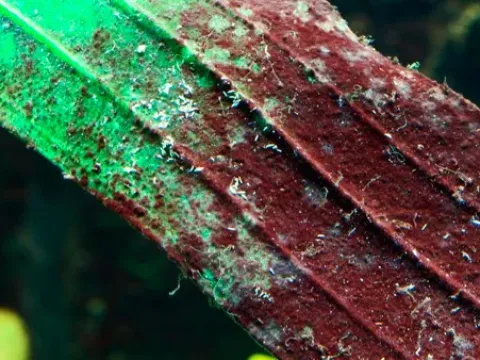
Cocconeis placentula
Cocconeis placentula
Cocconeis placentula is a unicellular diatom alga from the Bacillariophyta division, commonly found in freshwater ecosystems worldwide.
What the section contains
Cocconeis placentula
It is not a plant disease in the pathological sense, but it acts as an epiphyte, colonizing the surfaces of submerged aquatic plants, stones, and debris.
The organism features a characteristic bipartite silica shell known as a frustule, which provides structural integrity and environmental resistance.
Reproduction occurs primarily through binary fission, allowing the algae to form extensive biofilms on available substrates in a short period.
These diatoms rely on specialized mucilaginous secretions to establish a strong bond with plant surfaces, making them highly efficient colonizers.
The presence of Cocconeis placentula is visually identified by the formation of thin, brown or yellowish-brown coatings on leaves and stems.
These colonies often create a textured, somewhat slimy layer that may obscure the natural vibrant color of the host aquatic vegetation.
Microscopic examination of the affected areas reveals the presence of numerous elliptical valves, often arranged in dense, orderly patterns.
Plants affected by significant growth show signs of reduced vigor and a dull appearance due to the dense accumulation of algal cells.
Unlike necrotic diseases, the plant tissue underneath usually remains intact, although it suffers from severe light deprivation.
Growth is significantly stimulated by high levels of nutrients in the water, particularly phosphates and nitrates, typical in eutrophic conditions.
As photoautotrophs, Cocconeis placentula requires ample solar radiation to thrive, making well-lit areas the primary targets for colonization.
Slow-moving or stagnant water provides the ideal environment for the spores and cells to settle and successfully attach to the host plants.
Warm temperatures during the spring and summer months accelerate the metabolic activity and the reproduction rate of this diatom species.
The pH balance of the water, typically in the neutral to slightly alkaline range, supports optimal physiological functions for the algae.
The primary detrimental impact is the physical obstruction of light, which drastically reduces the photosynthetic efficiency of the host plant.
The dense biofilm prevents normal gaseous exchange between the leaf surface and the water, impeding the plant's respiration processes.
Long-term colonization can weaken the plant, leading to stunted growth, nutrient deficiency, and eventually leaf senescence or decay.
From an ornamental perspective, the accumulation of brown diatom film significantly detracts from the aesthetic value of aquarium or pond plants.
In dense colonies, the algae can also trap debris and other organic matter, creating a micro-environment that may attract secondary pathogens.
Managing water quality by limiting nutrient inputs is the most effective long-term strategy for suppressing diatom populations.
Introducing biological control agents, such as algae-eating fish or aquatic snails, can significantly help in maintaining clean plant surfaces.
Improving the water circulation and flow patterns in the tank or pond can disrupt the settlement process of these diatoms.
If necessary, careful mechanical removal using soft tools can clear the biofilm, provided the integrity of the plant tissue is maintained.
- Monitor phosphate and nitrate levels.
- Use biological cleaners (shrimp, snails, fish).
- Ensure proper lighting duration.
- Maintain adequate water circulation.