
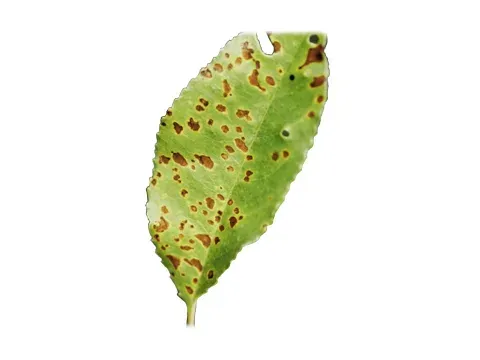
Coccotrema
Coccotrema
Coccotrema appears as specific growths or patches on the bark of trunks and scaffold branches. Visually, these manifest as grayish, greenish, or whitish spots that expand over time, adhering firmly to the bark surface.
What the section contains
Coccotrema
Unlike many pathogenic fungi, these lichens lack a root system penetrating deep into tree tissues. However, their presence visibly alters the bark's condition, making it rougher and creating a favorable environment for other organisms.
A distinctive feature is the presence of fruiting bodies, known as apothecia, which are immersed within the thallus in Coccotrema. They look like tiny dark dots or depressions scattered across the lichen surface.
The spread of lichen colonies can cover significant areas of a tree, obstructing sunlight from reaching the lenticels of the bark. This restricts the gas exchange between the trunk tissues and the surrounding environment.
As the lichen ages, its edges may curl, and the thallus can take on a more pronounced texture. In neglected cases, the bark coating becomes almost continuous, which indicates a long-term lack of proper maintenance.
Coccotrema is a genus of lichens consisting of a symbiotic relationship between a fungus (mycobiont) and an alga (photobiont). It is important to understand that this is not a parasitic disease in the traditional phytopathological sense, but rather an epiphyte.
The fungal component of the lichen provides protection for the alga against harsh conditions, while the alga synthesizes organic substances through photosynthesis. This symbiosis allows the organism to survive in conditions unsuitable for many other plants.
Systematically, these organisms belong to the class Lecanoromycetes. They are adapted to life on substrates that do not require rapid nutrient absorption, which dictates their slow growth rate.
The biology of Coccotrema is closely tied to the state of the host tree's bark. The lichen uses the bark surface merely as a mechanical anchor to stay in place and receive the necessary level of light.
Reproduction occurs primarily through spores, which are dispersed by wind or raindrops. Once landing on a suitable substrate with appropriate humidity, the spore germinates and begins to form a new thallus.
The primary condition for the development of Coccotrema is high humidity in the orchard. Lichens are extremely sensitive to water balance and grow actively where trees remain wet for long periods after precipitation.
Poor air circulation within the canopy is also a critical factor. Densely planted orchards and a lack of regular pruning create a microclimate with stagnant, humid air, which is ideal for the spread of lichen spores.
Trees with weakened immunity or damaged bark are more prone to colonization by epiphytes. Slow growth or a lack of new shoots in older trees provide a stable substrate where it is easier for the lichen to establish itself.
Air pollution from industrial emissions generally suppresses lichen growth; however, in clean orchard environments, their development can be intensive. In rural areas, high humidity is the dominant factor.
Seasonal temperature fluctuations also influence growth rates. Lichens develop most actively during periods of moderate temperatures accompanied by frequent fog or rain, which is typical for the spring and autumn seasons.
The direct harm from Coccotrema lies in the obstruction of the tree's natural respiration. By covering the bark pores and lenticels, the lichen indirectly suppresses the physiological processes of gas exchange.
Pest insects and pathogens often settle under the layer of lichens. Moisture trapped beneath the dense thallus creates a breeding ground for bark decay and the development of necrosis.
Coccotrema can serve as an indicator of the tree's general physiological weakening. If a tree is healthy and actively growing, the bark renews itself faster, which makes it difficult for lichens to establish a foothold.
Aesthetically, the presence of lichens reduces the market value of planting material and ornamental plants. In nurseries, the presence of large lichen colonies is considered a sign of insufficient agrotechnical control.
In cases of massive infestation, the overall vitality of the plant decreases. While the lichen itself does not kill the tree, it significantly facilitates the development of secondary pathogens, which can lead to the wilting of branches.
The primary method of control is mechanical cleaning. Using wooden scrapers or stiff brushes, lichens should be carefully removed from the bark during wet weather when they soften and separate from the substrate more easily.
After cleaning, it is recommended to disinfect the bark. Solutions based on iron sulfate or specialized fungicides with antiseptic properties have proven to be effective.
Proper canopy pruning is mandatory to improve ventilation. This reduces humidity levels in the trunk area and on the branch surfaces, which prevents the re-colonization of Coccotrema.
Timely trunk whitewashing with lime and the addition of copper sulfate is a classic preventive measure. This not only disinfects the bark but also creates an environment unfavorable for spore attachment.
Maintaining tree health through balanced fertilization and irrigation encourages rapid bark renewal. The more actively a tree grows, the harder it is for lichens to attach to its trunk.