
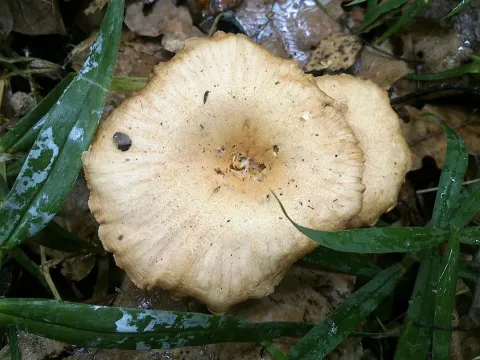
Clitocybe trulliformis
Clitocybe trulliformis
Clitocybe trulliformis is a saprotrophic fungus belonging to the Tricholomataceae family. This organism is not a phytopathogen of agricultural crops.
What the section contains
Clitocybe trulliformis
In biological classification, this species is part of the Basidiomycota division. The fungus's primary role in the ecosystem is the decomposition of organic matter.
The mycelium actively colonizes substrates, processing complex plant polymers. It is a typical reducer that does not infect living plant tissues.
The scientific name Clitocybe indicates the characteristic funnel-shaped cap. The specific epithet trulliformis emphasizes the resemblance of the fruit body to a ladle or scoop.
The fungus poses no direct threat to agrocenoses, as its activity is restricted to the soil layer and leaf litter.
The primary sign of its presence is the formation of fruit bodies on the soil or in the forest litter. The cap of the fungus has a grayish-white or ash-like hue.
The edges of the cap are rolled in young specimens, while maturing ones take on a distinctly ladle-like shape. The gills are crowded and decurrent along the stem.
The stem is cylindrical, often the same color as the cap or slightly lighter. The flesh has a specific mushroom-like odor, sometimes with a slight mealy nuance.
The spore print is white. Microscopically, the spores are oval or ellipsoid and smooth, which is an important sign for precise mycological identification.
Unlike pathogenic fungi, this species does not cause necrosis, spotting, or deformation on the leaves and stems of cultivated plants.
Normal development of the mycelium and the formation of fruit bodies require high air and soil humidity. The fungus prefers shaded areas of forests.
The temperature regime for mycelium growth usually varies within moderate ranges. The most active fruiting is observed during the autumn period.
The soil environment must be rich in organic matter, as its saprotrophic diet requires the presence of decomposing plant residues.
This species is often found in symbiosis with soil microorganisms, yet it does not form parasitic connections with the root systems of trees or grasses.
Microclimate changes, such as prolonged drought, can lead to a temporary cessation of fruit body formation in a specific habitat.
Clitocybe trulliformis does not cause damage to agricultural production. It is not a causative agent of diseases in vegetable, grain, or fruit crops.
The economic significance of this species is limited to its role in soil-forming processes. It contributes to the mineralization of organic matter in forest ecosystems.
The lack of phytopathogenic activity allows for this fungus to be classified as a neutral or beneficial component of the forest biocenosis.
The presence of the fungus in a field does not require any extermination measures or the application of fungicidal preparations.
A risk to agronomy could only arise in the case of erroneous identification, where a saprotrophic fungus is mistaken for a dangerous pathogen causing root rot.
Protection measures regarding this fungus are unnecessary. Agrotechnical interventions are not provided, as it does not cause any crop losses.
If the presence of mushrooms in the soil is deemed undesirable, it is recommended to improve the site's drainage to reduce excessive moisture that promotes mycelium growth.
Maintaining high agricultural standards, including the timely removal of plant residues, naturally limits the spread of saprotrophic fungi.
Prevention of genuine fungal crop diseases requires the use of crop rotation and resistant varieties, which is unrelated to the control of this saprotroph.
If fruit bodies need to be removed from a site, mechanical collection is sufficient, as the fungus does not possess an aggressive territory-conquering strategy.