
Catathelasma imperiale
Catathelasma imperiale
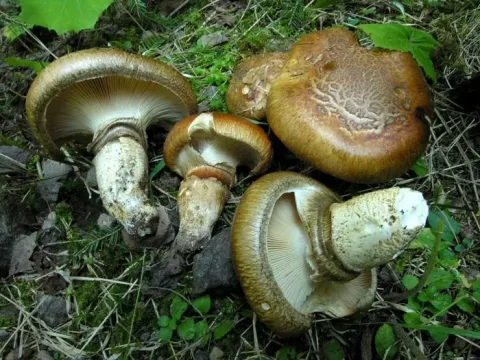
Catathelasma imperiale is a large and robust fungus, recognizable by its deeply rooted stipe which is often buried within the forest floor substrate.
What the section contains
Catathelasma imperiale
The cap typically displays a yellowish-brown to ochre color. Its surface may be slightly scaly, which provides a distinct texture compared to other forest mushrooms.
The gills are adnate to decurrent, descending onto the stem. They appear whitish in younger specimens and transition to a creamy hue as the fungus matures.
A diagnostic feature is the presence of a double ring on the stem, formed by the remnants of the partial and universal veils during the expansion of the fruit body.
The flesh is notably dense and white, maintaining its appearance even after being cut. It emits a characteristic, somewhat farinaceous odor typical of the genus.
This organism is not classified as a plant pathogen. It does not cause diseases in agricultural crops; rather, it occupies an ecological niche as a saprotroph.
The fungal mycelium plays an important role in the decomposition of organic matter in coniferous forests, contributing to nutrient cycling within the soil.
The biological life cycle of this species is integrated into the complex ecosystem of coniferous forests, relying on organic litter as a primary food source.
Morphological and genetic analysis confirms that Catathelasma imperiale is a unique member of the Tricholomataceae family, distinct from parasitic fungal species.
Reproduction is achieved through spore dispersal, which is facilitated by favorable moisture levels in the forest understory, ensuring the survival of the population.
The development of Catathelasma imperiale is restricted to mountain coniferous forests, where it thrives in shaded and humid environments among pine or spruce trees.
Optimal growth occurs in autumn, provided there is a consistent supply of moisture and moderate temperatures ranging between 8 and 15 degrees Celsius.
The species requires a thick layer of organic litter for the mycelium to establish itself. It is sensitive to soil compaction and disturbances in its habitat.
High relative humidity is essential for the maturation of the fruit bodies. Dry spells during the critical growth phase can lead to aborted or stunted development.
Ecological stability is a prerequisite for the survival of the species. Environmental degradation in forest areas poses a direct threat to its continued existence.