
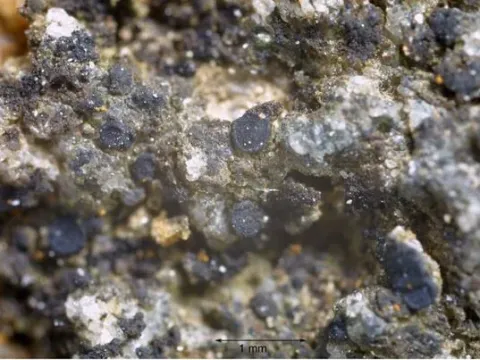
Catillaria chalybea
Catillaria chalybea
Catillaria chalybea is a species of crustose lichen belonging to the Catillariaceae family. It is strictly an epiphytic organism, not a pathogen, meaning it does not cause disease or biological harm to the trees or surfaces upon which it grows.
What the section contains
Catillaria chalybea
Like all lichens, it is a symbiotic association between a fungus and algae. The fungal component provides the structural framework and protection from environmental stress, while the algae carry out photosynthesis to produce energy.
The organism does not penetrate the cambium or phloem of the tree and does not extract nutrients from its host. Therefore, categorizing it as a "plant disease" is a common misconception in amateur gardening and horticulture.
Its reproduction relies on spores produced in apothecia, which are dispersed by wind. These spores settle on suitable surfaces and, if environmental conditions are appropriate, begin to form a new thallus.
From an ecological perspective, its presence is a sign of environmental stability and clean air, as many lichen species are highly sensitive to atmospheric pollution and industrial emissions.
The visual appearance of Catillaria chalybea is characterized by a thin, crust-like thallus that is often grey, steel-blue, or brownish in color. It adheres tightly to the bark, making it difficult to peel off without mechanical force.
Small, dark, disc-shaped apothecia are the key identification feature. These reproductive structures appear as tiny black or dark brown dots scattered across the surface of the lichen crust.
The lichen is usually observed on stable, rough surfaces such as the bark of mature trees, stones, or weathered wood. It does not create lesions, cracks, or rot on the bark, as it only occupies the surface layer.
The coverage of the lichen is usually patchy, tending to grow where light conditions are moderate and humidity levels remain relatively stable throughout the day.
During dry weather, the lichen may appear dull or brittle, but it regains a more vivid coloration and soft texture once hydrated by rain or high atmospheric humidity.
High relative humidity is the primary driver for the growth and colonization of Catillaria chalybea. It thrives in temperate regions with frequent rainfall, fog, and consistent moisture levels.
The species is highly sensitive to air quality. It is typically found in environments with low concentrations of sulfur dioxide and heavy metals, effectively acting as a bioindicator for cleaner air in gardens and forests.
Moderate light exposure is required for its development. It avoids both deep, dark shade and direct, scorching sunlight, preferring the semi-shaded areas of tree branches and trunks.
The substrate age is essential. It colonizes older, more established trees where the bark surface has become stable and less susceptible to shedding, providing a long-term base for growth.
Periods of prolonged drought do not kill the lichen but force it into a state of metabolic inactivity until favorable conditions return, allowing it to survive in fluctuating climates.
Catillaria chalybea causes no direct damage to crops, fruit yields, or the structural health of trees. It does not inhibit the tree's vital processes or lower its overall vigor.
There are no significant economic losses associated with this species. In fact, it contributes to the local biodiversity of the garden, playing a role in the intricate web of forest or garden life.
The only potential concern is cosmetic; many gardeners perceive an abundance of lichens as a sign of neglect, which may impact the aesthetic value of ornamental plants in certain landscape designs.
While the lichen is harmless, a dense population could theoretically provide temporary shelter for tiny herbivorous insects, although this is rarely a significant issue for well-managed trees.
Overall, the presence of this lichen should be viewed as an indicator of a balanced ecosystem rather than a threat that requires intervention or chemical control measures.
As this is not a disease, there is no need for chemical fungicides. If removal is desired for aesthetic reasons, mechanical methods are the most effective and safest approach for the tree.
Manual cleaning of the bark using a soft wire or nylon brush in early spring is sufficient to remove lichen growth and keep the bark looking clean and well-maintained.
Whitewashing the trunk with a lime-based solution (often mixed with copper sulfate) creates a temporary alkaline environment on the surface, which is unsuitable for the growth of lichens and mosses.
Proper pruning is essential to improve airflow through the canopy. By increasing ventilation and light penetration, the humidity levels around the branches decrease, making the environment less favorable for lichen spread.
Maintaining high tree health through proper fertilization and watering promotes healthy bark growth, which naturally limits the available space for lichen colonization and keeps the tree in a vigorous state.