
Byssoloma marginatum
Byssoloma marginatum
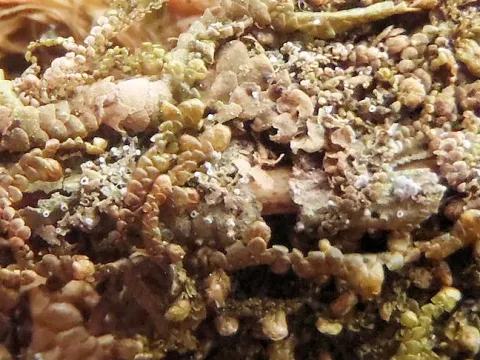
Byssoloma marginatum is a crustose lichen species that grows on the bark of living trees and the leaves of various evergreen plants.
What the section contains
Byssoloma marginatum
It typically appears as thin, translucent or pale grayish spots on the surface, characterized by a distinct margin along the edges of the thallus.
The organism produces small reproductive structures known as apothecia, which appear as tiny, dark-colored disks with raised borders.
Unlike parasitic fungi that cause plant diseases, this lichen does not penetrate the living tissue of its host to extract nutrients.
Because it is often found on tree trunks, it is frequently misidentified as a fungal pathogen, although it causes no necrosis or decay.
Byssoloma marginatum is not a plant pathogen; it is a symbiotic organism consisting of a fungus and an alga or cyanobacteria living together.
The fungal partner provides the physical structure and protection, while the photosynthetic partner produces the energy required for survival.
This species is classified as an epiphyte, using the plant host only as a physical substrate rather than as a source of nutrition.
There is no evidence that this lichen releases substances that interfere with the metabolic processes or health of the host tree.
It exists entirely on the surface, making it ecologically distinct from true diseases that attack plant cells and vascular systems.
Growth of Byssoloma marginatum is largely dictated by high air humidity and a sheltered microclimate, typical of dense woodlands or gardens.
It thrives in areas with diffused or moderate light and is generally intolerant of direct, harsh solar radiation that can dry out its thallus.
As a sensitive lichen species, it serves as an bioindicator of clean air, rarely surviving in heavily polluted industrial or urban environments.
Old trees with rough or deeply fissured bark provide the ideal surface, as these textures are capable of retaining moisture for longer periods.
A mild temperature regime supports the vegetative expansion of this lichen throughout the active growing seasons of the host plants.
There is no scientific basis to consider Byssoloma marginatum harmful to trees or agricultural crops, as it does not parasitize the plant.
While some growers might find its presence aesthetically unappealing on prized ornamental trees, it does not reduce the vigor of the plant.
In some scenarios, thick lichen coverage could theoretically harbor overwintering insect pests, providing them with a temporary shelter.
However, for mature trees, the colonization of the bark by this lichen is entirely harmless and does not affect the tree's health or fruit yield.
It is essentially a neutral occupant of the tree's surface, reflecting the ecological health of the local environment rather than posing a threat.
No chemical control measures are recommended, as Byssoloma marginatum does not function as a disease and poses no threat to plant viability.
If removal is desired for aesthetic reasons, a simple mechanical cleaning with a soft brush during a dormant period is usually sufficient.
Standard horticultural practices such as pruning to improve air circulation and sunlight penetration naturally discourage the establishment of lichens.
Common fungicides used to treat genuine plant diseases may incidentally affect lichen growth, but this should not be the purpose of treatment.
The most effective management is ensuring optimal tree health through proper fertilization and watering, which promotes vigorous bark growth.