
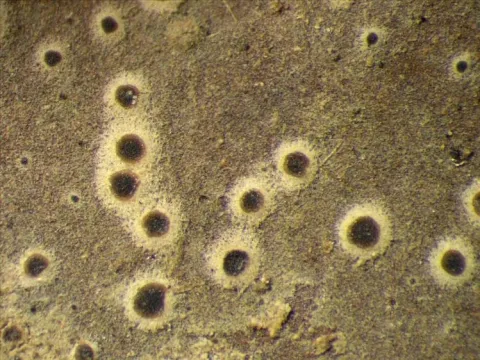
Byssoloma
Byssoloma
Byssoloma is a genus of lichenized fungi that frequently colonize the leaves and bark of plants in tropical and subtropical environments.
What the section contains
Byssoloma
These organisms do not act as parasitic pathogens; they do not extract nutrients directly from the host plant's internal tissues.
Biologically, Byssoloma functions as a lichen, establishing a symbiotic relationship with algae to survive on the leaf surface.
The plant serves merely as an anchor or substrate, providing the necessary elevation and surface for the lichen to access light and ambient moisture.
Taxonomically, it belongs to the Pilocarpaceae family, characterized by specific apothecia that distinguish it from other lichen genera.
The most visible sign of Byssoloma is the appearance of small, distinct, and flat or slightly convex spots on the leaf surface.
The colonies appear as a pale green or greyish thin crust that adheres firmly to the leaf cuticle.
Observers can identify the fungus by the presence of small, disc-shaped fruiting bodies known as apothecia located along the edges of the thallus.
Unlike true plant diseases, the underlying leaf tissue usually remains healthy and free of necrosis or chlorosis at the site of attachment.
These colonies are typically found on the underside of evergreen leaves, particularly in shaded and humid environments.
Byssoloma thrives exclusively in environments characterized by consistently high relative humidity and low evaporation rates.
The development of these lichen colonies is favored by shaded, stagnant air conditions where moisture remains on foliage for extended periods.
It prefers regions with significant rainfall and stable, warm temperatures that prevent the desiccation of the fungal thallus.
Plants in dense, overcrowded settings are significantly more prone to colonization due to the lack of air movement between the leaves.
The presence of Byssoloma often indicates a high-quality, pollution-free environment, as these organisms are highly sensitive to air contaminants.
While not a primary plant killer, Byssoloma can negatively impact plant health by physically shading the leaf surface.
Extensive colonization blocks sunlight, thereby inhibiting the efficiency of photosynthesis in the affected parts of the foliage.
For ornamental and nursery plants, the presence of these lichen patches significantly reduces commercial and aesthetic value.
The points of attachment may create micro-niche environments where dust and moisture accumulate, potentially fostering other opportunistic organisms.
In cases of severe overgrowth, the physiological stress caused by reduced light exposure can lead to stunted growth in young or sensitive plants.
Effective management of Byssoloma relies primarily on adjusting the growing environment rather than using systemic pesticides.
The most crucial step is ensuring adequate ventilation and airflow around the plants to prevent the moisture buildup required by the lichen.
Regular pruning and proper spacing of ornamental plants are highly effective methods for reducing the surface area available for colonization.
Mechanical removal is easily achieved by gently wiping the affected leaves with a mild soapy solution during regular maintenance.
If necessary, dilute copper-based fungicides applied during routine garden health checks will successfully eliminate the lichen without damaging the host.