
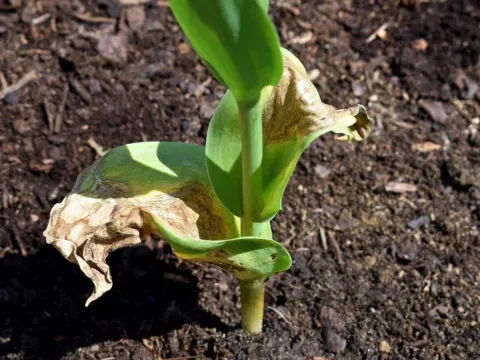
Tulip fire
Botrytis tulipae
The causative agent of this disease is the fungus Botrytis tulipae, a specialized parasite that exclusively affects plants of the genus Tulipa.
What the section contains
Tulip fire
This pathogen belongs to the class of imperfect fungi and reproduces by creating abundant gray conidia, which are easily disseminated by wind, rain splashes, and gardening tools.
The fungus produces survival structures known as sclerotia, which allow it to persist in the soil and on infected bulbs for several years, even in the absence of a host.
Primary infection in the spring is triggered by the germination of these overwintered sclerotia, which invade the emerging shoots and leaves of the tulip.
Secondary spread occurs through the continuous production of conidia throughout the growing season, especially under favorable environmental conditions.
Initial symptoms include small, light-colored, sunken spots on leaves, stems, and flower buds, which gradually turn brown or grey as the tissue dies.
Under high humidity, these spots expand rapidly and become covered with a dusty, grayish fungal growth, which gives the disease its common name, 'Tulip Fire'.
Affected stems often become twisted or bent, frequently breaking at the point of infection, which prevents the proper development of the flower.
Bulbs may show yellowish or dark brown spots, sometimes with a defined darker border, leading to tissue softening and rotting during storage.
- Stunted growth of infected tulip plants.
- Leaf curling and deformation of flower stems.
- Presence of tiny black sclerotia on the surface of bulb scales.
The development of Botrytis tulipae is highly dependent on environmental conditions, particularly high humidity levels exceeding 80% and frequent rainfall.
Optimal temperatures for the fungal development range from 15 to 20 degrees Celsius, which often coincides with the tulip's active growth period in spring.
Poor ventilation and overcrowded planting conditions trap moisture on the foliage, providing the necessary film of water for fungal spores to germinate and infect the host.
Mechanical damage to the plant, caused by spring frost or pests, significantly increases the susceptibility of tulips to fungal penetration.
Warm and humid weather, combined with lack of airflow in the canopy, creates a perfect environment for rapid transmission of the disease within the garden bed.
Tulip fire causes significant aesthetic damage to floral displays, leading to the rapid wilting and collapse of flower buds and entire plants.
Infected bulbs have lower energy reserves, which compromises their ability to produce healthy flowers in subsequent growing seasons, often leading to total bulb decline.
Storage rot is a major threat, as the fungus can spread from a single infected bulb to the entire stock, resulting in substantial economic loss for growers.
Reduced photosynthetic capacity due to widespread leaf spotting prevents the bulb from maturing properly, leading to poor bulb quality and size.
If left uncontrolled, the presence of sclerotia in the soil can make the area unsuitable for future tulip cultivation for several years.
Implementing a proper crop rotation strategy is essential; do not replant tulips in the same location for at least three to four years to allow sclerotia in the soil to die off.
Rigorous inspection and sorting of bulbs before planting and storage are crucial to ensure that only healthy, spot-free material is kept.
Preventive application of fungicides during the active growth phase can effectively protect the plants from infection by air-borne conidia.
Promptly removing and destroying any plants showing symptoms of the disease helps to break the infection cycle and limits the spread to neighboring plants.
Treating bulbs with a fungicide soak before planting is an effective measure to disinfect the exterior and prevent early infection of the developing plant.