
Tulip smut
Ustilago tulipae
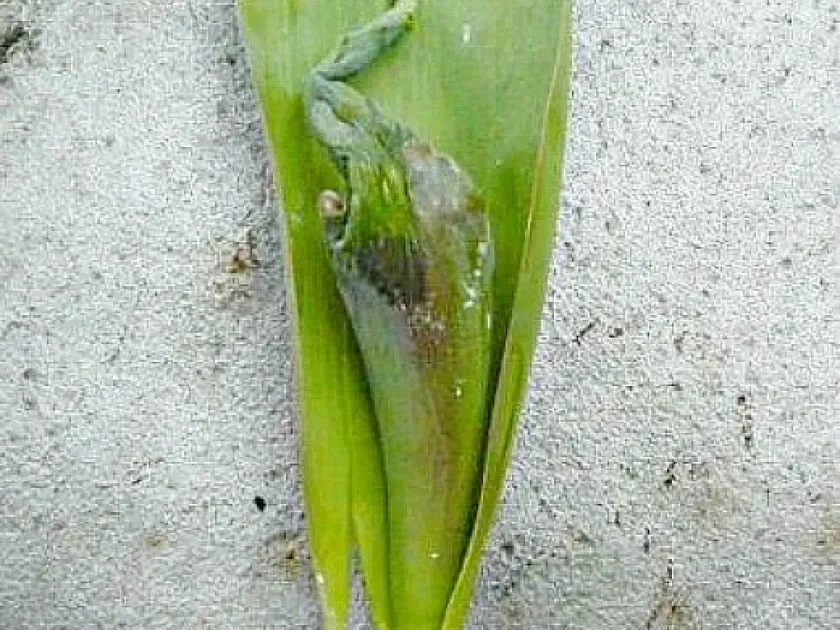
Description
Symptoms
Symptoms of tulip smut become apparent during the early growth stages; affected plants often appear stunted and fail to reach their full potential height.
Leaves frequently exhibit significant malformations, such as curling or twisting, and often show pale yellow or chlorotic longitudinal striping.
The most distinctive sign is the formation of dark, soot-like spore masses that erupt through the epidermis of the leaves and stems as the plant matures.
When inspecting the bulbs, you may notice dark, sunken lesions or irregular spots on the scales, which often indicate the presence of the fungal infection.
Flowers on infected plants are either completely absent or, if present, are severely distorted, shriveled, and fail to open properly.
Pathogen
The causal agent of this disease is the fungus Ustilago tulipae, which belongs to the Ustilaginaceae family. This pathogen is a highly specialized fungus that targets bulbous plants, specifically tulips.
The fungus survives as dormant spores, known as teliospores, which can remain viable in the soil or adhere to the surface of dormant bulbs during storage.
Biologically, the pathogen acts by systemic infection; it colonizes the bulb tissue and follows the growing point of the plant as it develops during the spring season.
The primary mode of transmission is the exchange of infected bulbs, which often show no visible signs of the fungus until the plant begins to grow.
Under favorable conditions, the mycelium of the fungus penetrates the plant tissues, eventually producing masses of black spores that replace the healthy plant cells.
Conditions for development
The disease thrives in cool, wet soil conditions, particularly during the early spring when young shoots are just emerging from the bulbs.
Poor soil drainage and low aeration contribute significantly to the development of the fungus, as excessive moisture allows the spores to germinate more effectively.
High humidity levels in storage facilities are a major risk factor, as they facilitate the spread of spores from infected bulbs to healthy ones in the same container.
Planting depth also plays a role; bulbs planted too deeply in compacted, waterlogged soil are more susceptible to infection compared to those in well-drained, loose soil.
Continuous monoculture, where tulips are grown in the same location year after year, allows for the accumulation of the pathogen in the soil over time.
Why it matters
Tulip smut is highly destructive to the aesthetic value of horticultural displays, rendering infected flower beds useless for public or private viewing.
For commercial growers, an outbreak of this disease can result in significant financial losses due to the required destruction of entire lots of bulb stock.
The pathogen is difficult to eradicate once established in the soil, which prevents the safe replanting of host species in the affected area for several years.
It severely reduces the propagation rate of tulips, as infected mother bulbs rarely produce viable daughter bulbs, eventually leading to the loss of entire plant collections.
The disease weakens the overall vigor of the plants, making them more susceptible to secondary environmental stresses and opportunistic bacterial infections.
Protection
The most effective management strategy is strict sanitation: carefully inspect all incoming bulb shipments and discard any showing signs of damage or decay.
Treat bulbs with systemic fungicides prior to planting, specifically those labeled as effective against smut and similar soil-borne fungal pathogens.
Maintain a strict crop rotation schedule, avoiding the use of the same planting site for tulips for at least three to four consecutive years after an infection occurs.
Ensure that soil is well-draining and improve aeration, as these measures significantly lower the probability of successful fungal colonization.
- Remove and destroy all infected plants, including the roots and surrounding soil, immediately upon detection.
- Sanitize all gardening tools with bleach or alcohol solutions after use to prevent the mechanical spread of spores.
- Ensure optimal ventilation and low humidity during the storage of dormant bulbs to minimize fungal growth.
Discussion
No discussions yet — be the first.