
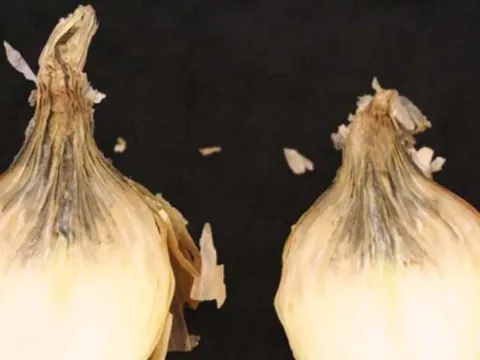
Neck rot of onion
Botrytis aclada
The causative agent of this disease is the fungus Botrytis aclada (formerly known as Botrytis allii). It is a major pathogen of onion crops that predominantly causes rot during the post-harvest storage period.
What the section contains
Neck rot of onion
The fungus survives in the soil and on crop residues in the form of mycelium or sclerotia. It spreads through windborne spores or through soil contamination, infiltrating the plant tissues during the growing season.
This pathogen is highly specialized in onion and related Allium species. It possesses sophisticated enzymes that degrade cellular pectin, allowing it to penetrate and colonize the succulent scales of the onion bulb.
Botrytis aclada is a persistent pathogen. Even if the onion plant looks healthy in the field, the infection often remains latent, manifesting only when the environmental conditions become favorable for fungal growth.
Understanding the biology of this fungus is crucial for farmers, as the pathogen lifecycle is strictly dependent on moisture availability and the physical integrity of the onion bulb's neck.
The first symptoms typically appear as a softening of the tissue around the neck of the bulb. The affected area becomes water-soaked and eventually turns into a greyish, mushy rot.
A distinctive dense, grey, fuzzy mold develops on the infected tissues. This mass consists of masses of conidia, which are the spores that facilitate the secondary spread of the disease to adjacent bulbs.
Small, hard, black structures called sclerotia often form on the surface or between the onion scales. These structures are durable survival bodies that allow the fungus to endure harsh conditions.
In severe cases, the entire bulb becomes completely degraded, emitting a sharp, unpleasant odor. Internal examination reveals the scales have separated and lost their firm texture, resembling cooked plant tissue.
In the field, infected plants might exhibit yellowing of the leaf tips and prematurely drooping foliage. When pulled, the neck of the bulb feels soft and spongy rather than firm and dry.
High relative humidity is the primary driver of neck rot development. During the harvest period, if the weather is rainy or damp, the necks of the onions cannot dry properly, leaving them vulnerable to infection.
Temperature plays a significant role in fungal activity. Botrytis aclada thrives in moderate temperature ranges, typically between 15°C and 20°C. Storage temperatures that are too high can significantly accelerate rot.
Poor ventilation is the major factor contributing to outbreaks in storage facilities. Stagnant air allows moisture to accumulate on the bulb surfaces, creating a perfect environment for spores to germinate.
Mechanical damage is a key precursor to infection. Bruises, cuts, and scrapes sustained during harvest or transport provide direct entry points for the fungal spores to colonize the interior of the onion.
Excessive nitrogen fertilization can lead to overly succulent, late-maturing bulbs that do not cure well. Such onions are significantly more susceptible to neck rot than those grown with balanced nutrition.
Neck rot is one of the most destructive diseases for stored onions worldwide. It is capable of destroying entire batches of produce, leading to substantial economic losses for growers and retailers.
The disease impacts both the quality and marketability of the crop. Infected onions are entirely unpalatable and cannot be used for food production, necessitating their immediate disposal.
The logistical cost of dealing with neck rot is high, as it requires labor-intensive sorting and re-grading of stored onions. Even a low percentage of initial infection can spread to healthy bulbs in the same bin.
Beyond direct economic impact, neck rot affects the supply chain consistency, causing shortages and price volatility if large volumes of stored onions are lost during the winter season.
The latent nature of the pathogen makes it difficult to detect during initial harvest, leading to unexpected and large-scale failures during long-term storage programs.
The most effective strategy is to ensure proper curing of the crop. Onions must be harvested in dry conditions and cured in a well-ventilated area until the neck is completely dry and constricted.
- Implement long-term crop rotation cycles of 3 to 4 years to reduce soil inoculum.
- Ensure adequate spacing between plants to maximize air circulation in the field.
- Avoid over-fertilizing with nitrogen to ensure proper maturity and curing of the bulbs.
- Maintain storage temperatures as close to 0°C as possible to minimize fungal metabolic activity.
- Sanitize storage facilities and crates annually before filling them with a new harvest.
If environmental conditions during the growing season are conducive to infection, preventive fungicide applications may be necessary. Use only registered products and follow strict pre-harvest interval guidelines.
Gentle handling during harvesting and sorting is critical to avoid mechanical damage. Minimizing the number of touchpoints reduces the potential for fungal spores to colonize the bulbs.
Continuous monitoring of stored produce, including periodic checking of bulb firmness, can help detect outbreaks early, allowing for the isolation of infected lots to prevent a total loss.