
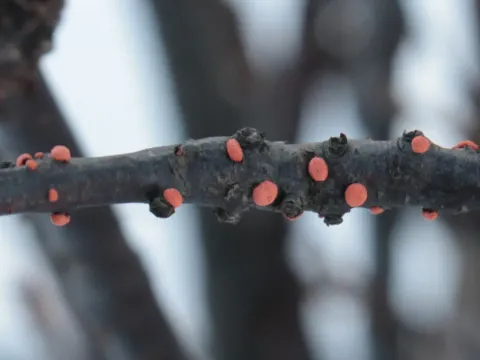
Nectria canker
Nectria inventa
The causative agent of the disease is the imperfect fungus Nectria inventa (syn. Acremonium inaequalis). This pathogen belongs to the Ascomycota phylum and often exists as a saprotroph on decaying organic matter, but it can act as a parasite under favorable conditions.
What the section contains
Nectria canker
The fungus survives in the soil and on plant debris as mycelium or conidia. The conidiophores of the fungus form distinct branched structures, often exhibiting an olive-green coloration, which serves as a key diagnostic feature for identification.
The pathogen spreads primarily through conidia, which are disseminated by wind, rain splashes, and insects. Spores germinate in high humidity, penetrating host tissues through wounds, frost cracks, or leaf petiole scars.
A biological characteristic of Nectria inventa is its ability to quickly colonize weakened tissues, allowing it to transition from feeding on dead organic matter to actively attacking living shoots. The life cycle may also include an ascigerous stage with perithecia.
The fungus is highly resilient to temperature fluctuations, enabling it to survive in temperate climates throughout the year and reactivate quickly during the first warm days of spring.
The main sign of Nectria canker is the appearance of localized necrotic areas on the bark, which gradually expand. The infected bark turns brown or reddish-brown and often cracks along the edges.
Fungal cushions develop on the affected areas. Initially light in color, they become olive-green as spores mature, which differentiates this canker from other types of necrosis that have darker sporulation patterns.
Gummosis (exudation of gum) is frequently observed, particularly in stone fruit trees. Leaves above the infection site often turn yellow, curl, and wither due to the disruption of the vascular system in the branch.
When young shoots are infected, they may bend or dry out at the tips. If the necrosis girdles the branch, the distal part of the plant will eventually die.
- Darkening of the bark and formation of ulcers.
- Olive-green fungal growth on affected areas.
- Wilting and drying of individual branches.
- Bark cracking and peeling.
- Exudate secretion at active infection sites.
High humidity and moisture levels favor the development of the infection, especially during prolonged rainy spring periods. The optimal temperature for mycelial growth ranges between 15 and 22 degrees Celsius.
Plants weakened by low winter temperatures are the most vulnerable to Nectria inventa. Frost cracks on the bark act as entry points for the pathogen into the wood.
Dense, poorly ventilated plantings create a microclimate with stagnant moist air, significantly accelerating the spread of conidia. Improper pruning also creates new entry points for infection.
Neglected orchards where fallen leaves and dead twigs accumulate become reservoirs for the pathogen. High spore concentration ensures a constant threat to healthy trees.
Imbalanced nutrition, especially excessive nitrogen fertilization, promotes lush growth of tender tissues, which are more susceptible to fungal attack due to lowered natural plant immunity.
The primary damage is the premature death of branches, which deforms the crown and reduces overall tree productivity. The plant loses a significant portion of its photosynthetic apparatus.
In cases of severe outbreaks, the disease can cause the death of young seedlings and major scaffold branches of adult trees, necessitating drastic sanitary measures.
Fruits affected by the pathogen lose their market value and are prone to secondary infections by other decay-causing microorganisms during storage, shortening their shelf life.
Prolonged exposure to the disease depletes the plant's immune resources, making it more susceptible to other pests and diseases, leading to a general decline in the orchard's productive potential.
In nursery production, Nectria canker can result in the rejection of entire batches of nursery stock due to the inability to maintain healthy growth.
The fundamental control method is regular sanitary pruning, removing all dead and infected branches while cutting into healthy tissue, followed by disinfecting wounds with copper-based agents or specialized pruning pastes.
Ensuring proper crown aeration through correct thinning cuts helps reduce internal humidity and creates unfavorable conditions for spore germination.
Preventive application of copper-based fungicides in early spring and autumn after leaf fall significantly reduces the infectious background. Systemic fungicides from the triazole group are also effective during the growing season.
Protecting trunks and scaffold branches from frost cracks by whitewashing prevents the pathogen from entering through mechanical bark damage.
Thorough cleaning of the area beneath the trees, removing all fallen leaves and debris that serve as overwintering sites for spores, is essential for disease suppression.