
Boletus speciosus
Boletus speciosus
Boletus speciosus (often reclassified as Butyriboletus speciosus) is a wild mushroom species commonly known as the Red-pored Bolete. It is not a plant disease and does not cause agricultural damage.
What the section contains
Boletus speciosus
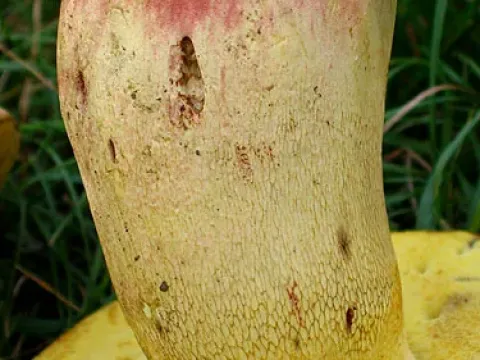
The mushroom features a rose-red to pinkish cap, which can fade to yellow. Its most notable characteristic is the bright yellow pore surface that turns blue almost immediately upon bruising or cutting.
The stem is robust, yellow, and usually features a delicate reticulation. The flesh is white to yellow but shifts color rapidly when exposed to air, which is a key diagnostic feature for mycologists.
This species typically grows in association with deciduous trees, forming mycorrhizal relationships. It thrives in forest environments rather than agricultural fields or crop rows.
Because it is a wild forest mushroom, it cannot be classified as a pathogen or a disease that affects crops, vegetables, or ornamental plants.
Biologically, Boletus speciosus is a saprotrophic and mycorrhizal fungus. It exists as a symbiont to trees and plays a crucial role in nutrient recycling in the forest floor.
Unlike parasitic fungi that attack living host cells to obtain energy, this mushroom lives in harmony with its host trees, exchanging nutrients for carbohydrates.
It lacks the enzymes and biological mechanisms required to penetrate, infect, or colonize living tissues of cultivated agricultural crops.
There is no taxonomic or agronomic evidence suggesting that this mushroom acts as a plant pathogen or causes any physiological disorder in crops.
Any association of this name with plant disease lists is scientifically incorrect and does not reflect actual botanical or agricultural facts.
The development of Boletus speciosus fruit bodies requires specific environmental conditions, including high humidity and acidic to neutral soil rich in organic matter.
It favors shaded areas under canopy trees, such as oaks and beeches. These environments are the opposite of the high-disturbance, high-input settings found in agricultural production.
Spores are dispersed by natural vectors such as wind and insects. They do not target crop surfaces, as the fungus requires a woody host to establish its mycelium.
Seasonal patterns, specifically warm summer and autumn periods following rainfall, are the primary drivers of its growth cycles.
The presence of this fungus in or near an orchard suggests healthy forest soil conditions but does not pose a threat to the horticultural health of the trees.
This mushroom causes zero harm to agricultural productivity. It does not compete with crops for light, water, or soil nutrients and is entirely innocuous in an agronomic context.
The only risk associated with the species is human consumption. It is generally considered non-edible due to its extremely bitter taste and reports of potential gastrointestinal distress.
It is not a competitor or a threat, and it requires no control measures, chemical applications, or quarantine protocols in any part of the world.
Farmers do not need to invest resources into its eradication, as it is a natural part of the local ecosystem that does not cross the boundary into agricultural land.
In summary, Boletus speciosus should be viewed as a forest mushroom species rather than an agent of plant disease or agricultural destruction.
No protection or control measures are required. Since the fungus is not a pathogen, any form of chemical intervention is unnecessary and environmentally counterproductive.
Should the presence of the mushroom be undesirable on a residential property, simple mechanical removal is sufficient to clear the fruit bodies.
No agricultural fungicides are recommended for this species, as its biology is not targeted by standard crop protection chemicals.
Prevention is not necessary because the fungus does not infect crops and will not spread to agricultural fields through standard cultivation practices.
Focusing on genuine soil-borne pathogens or pests is the recommended approach for maintaining healthy crop production, while leaving harmless forest species undisturbed.