
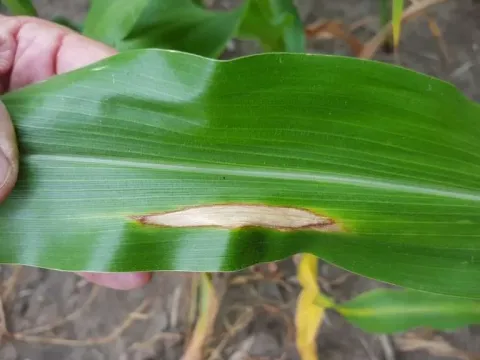
Southern corn leaf blight
Bipolaris maydis
Southern corn leaf blight is caused by the fungal pathogen Bipolaris maydis (previously known as Helminthosporium maydis). This fungus belongs to the Ascomycota phylum and is a significant threat to corn production worldwide.
What the section contains
Southern corn leaf blight
The pathogen survives primarily in crop residues left on the soil surface, where it maintains its viability through mycelium or conidia until the following growing season.
Infection cycles are driven by the production of conidia, which are wind-dispersed or splashed onto the host plant during periods of high humidity and rainfall.
There are different races of the fungus, with Race T being historically famous for causing severe damage to hybrids containing the Texas male-sterile (T) cytoplasm.
The fungus penetrates the leaf tissue directly or through stomata, establishing infection centers that expand rapidly under favorable environmental conditions.
The disease typically begins with small, elongated, tan to reddish-brown lesions appearing on the lower leaves of the corn plant.
These lesions often exhibit a distinct light-colored center surrounded by a darker brown border, giving them a classic "spindle" shape appearance.
As the disease progresses, lesions can merge, causing large sections of the leaf tissue to wither, turn brown, and die prematurely.
Under humid conditions, a characteristic olive-brown or greyish fungal sporulation becomes visible on the surface of the lesions.
In severe infections, the fungus may spread to the leaf sheaths, husks, and even the grain itself, often leading to secondary rot and poor seed set.
The development of Bipolaris maydis is heavily favored by warm temperatures, typically ranging from 20°C to 30°C (68°F to 86°F).
High relative humidity and frequent rainfall or heavy dew are essential for the germination of spores and the establishment of new infection sites on the host.
Continuous corn cropping systems are highly susceptible because they allow the pathogen to build up high levels of inoculum in the soil and crop debris.
Fields with dense canopy cover or poor air circulation trap moisture, creating a microclimate that significantly speeds up the infection process.
Nutrient deficiencies, particularly low potassium levels, can make plants more susceptible to infection, while excessive nitrogen may promote succulent growth that is easily colonized.
The primary impact of the disease is the reduction of the photosynthetic capacity of the plant due to extensive leaf damage and premature senescence.
Significant leaf area loss leads to reduced grain filling, lower test weights, and overall lower yields for the affected harvest.
Infected stalks and ears are more prone to secondary pathogens, which can cause stalk rot and ear rot, potentially leading to significant lodging before harvest.
The presence of the fungus can also contaminate grain with mycotoxins, which can affect the quality of the harvested corn and its suitability for animal feed.
In extreme cases of epidemic spread, farmers may experience substantial financial losses due to both reduced volume and degraded quality of the grain.
The most effective long-term management strategy is the use of resistant or tolerant corn hybrids that can withstand the pressure of the pathogen.
Crop rotation with non-host crops like soybeans or wheat is highly recommended to break the life cycle of the fungus and reduce soil-borne inoculum.
Tillage practices that incorporate corn residues into the soil promote the breakdown of debris and help decrease the amount of available fungal spores.
Fungicide applications during the vegetative or reproductive stages can be effective, provided they are applied early enough after the first symptoms are detected.
General good field management, including balanced fertilization and timely weed control, helps maintain plant vigor and increases resistance to infections.