
Beech woodwart
Xylaria carpophila
Description
Symptoms
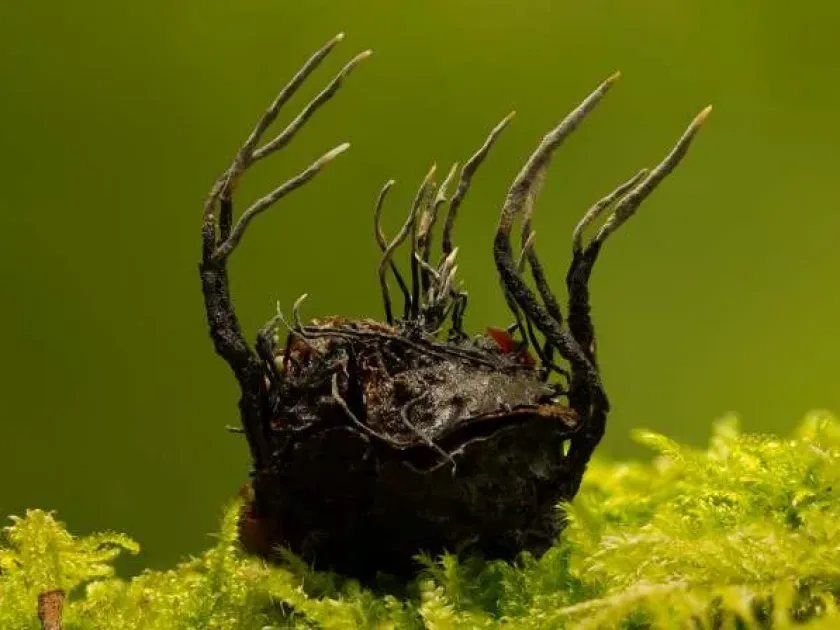
The most distinctive sign of Xylaria carpophila is the presence of slender, dark, erect stalks growing directly from beech mast on the soil surface.
During the active stage of spore production, the tips of the stromata may appear covered in a whitish or greyish powder. This represents the conidial stage of the fungus's lifecycle.
Infected beech seeds undergo tissue softening and discoloration. As the mycelium permeates the material, the fruit structure loses its integrity and darkens significantly.
Mature fruiting bodies are tough and carbonaceous, often persisting throughout the winter months. They are easily identified by their solid, black appearance, which stands out against leaf litter.
Detection is most successful during damp, overcast weather when the fruiting bodies are hydrated and most visible to the naked eye during field assessments.
Pathogen
Beech woodwart (Xylaria carpophila) is a species of fungus in the family Xylariaceae. It is primarily a saprotrophic organism that specializes in breaking down the fruit husks of beech trees.
The pathogen produces characteristic fruiting bodies known as stromata. These structures are hard, woody, and typically black, resembling small horns or twigs protruding from the debris.
As a member of the Ascomycota phylum, Xylaria carpophila develops its spores within specialized sacs. This biological adaptation allows the fungus to remain viable for long periods in diverse environmental conditions.
The fungus functions as a decomposer, utilizing cellulose and other organic compounds found in fallen fruit shells. It is an essential component of the forest floor ecosystem, assisting in nutrient cycling.
While primarily a saprotroph, the fungus can behave opportunistically. Under specific environmental stresses, it may colonize seeds or seedlings, making it a point of interest for forest nursery managers.
Conditions for development
The development of Beech woodwart is highly dependent on humidity. High moisture levels in the forest floor litter are essential for the initiation of fruit body formation.
Shaded environments with significant accumulation of organic debris create an ideal microclimate for the fungus. Such conditions are frequently found in dense, closed-canopy forest stands.
Temperature fluctuations have a secondary effect on growth, yet moderate autumnal temperatures provide the best balance for rapid colonisation of new substrate material.
The availability of beech nuts is the primary limiting factor for population expansion. In years with low nut production, the fungus remains dormant or limited to localized areas.
Soil structure and aeration play a role in the health of the population. Compacted or waterlogged soils can alter the microbial balance, sometimes favoring the spread of wood-decaying fungi.
Why it matters
Beech woodwart is primarily a nuisance in forest nursery settings. It can compromise the quality of stored or sown seeds, leading to a reduction in overall germination rates.
By attacking the seed coat and inner tissues, the fungus can kill embryos before they emerge. This results in patchy or sparse seedling emergence, requiring replanting efforts.
Although it does not pose a major threat to healthy, mature trees, its presence can indicate an overabundance of decaying organic matter, which may be associated with other forest pests.
Economic losses arise from the necessity of fungicide treatments for seeds intended for reforestation programs, adding to the cost of sustainable forest management.
In areas where seed production is being optimized for selection, the presence of this fungus is considered a negative factor that requires strict phytosanitary oversight.
Protection
Effective management begins with strict sanitation. Removing or clearing away excessive beech debris from nursery plots is the most reliable way to lower the inoculum density.
Deep soil cultivation helps bury organic debris, accelerating its decomposition by soil microorganisms and physically preventing the formation of fruiting bodies.
Treating seeds with approved fungicides prior to sowing provides a protective layer, significantly reducing the success rate of fungal colonization on the seeds themselves.
Improving drainage and light penetration in nurseries reduces the surface humidity, making the environment less conducive to the growth of Xylaria fruiting structures.
Regular monitoring of seedbeds allows for the early detection of infections. If high levels of contamination are found, implementing a crop rotation cycle can help reset the soil's fungal population.
Discussion
No discussions yet — be the first.