
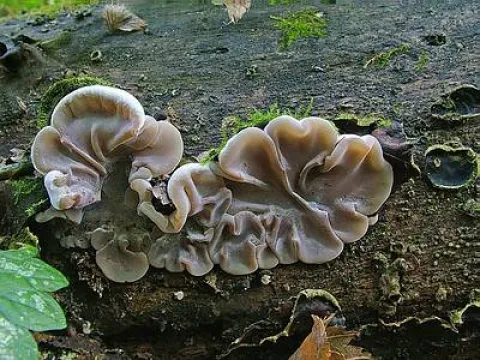
Auricularia mesenterica
Auricularia mesenterica
The causal agent is the basidiomycete fungus Auricularia mesenterica, belonging to the Auriculariaceae family. This wood-decaying fungus acts primarily as a saprotroph, though it can occasionally behave as a weak parasite.
What the section contains
Auricularia mesenterica
The fungal mycelium penetrates deep into the wood structure, causing active decomposition. The fungus forms fruit bodies with a characteristic gelatinous, cartilaginous consistency that becomes hard and horny when dried.
The life cycle of the pathogen is closely linked to the presence of dead or weakened wood, where it undergoes sexual reproduction stages. The fungal spores are spread by air currents and germinate upon landing on damaged bark surfaces.
Unlike many other pathogens, Auricularia is capable of maintaining viability within a woody substrate for long periods. It gradually breaks down lignin and cellulose, leading to a complete loss of structural integrity in the affected areas.
Biologically, this species is adapted to a wide range of temperatures, allowing it to colonize wood effectively in various climatic zones. Its development is a crucial step in the natural nutrient cycling process within forest ecosystems.
The main sign of infection is the appearance of ear-shaped or effused fruit bodies on trunks and branches. They often fuse together, forming extensive, imbricate groups.
The surface of the fruit bodies is typically grayish-brown and covered with fine hairs, while the inner hymenophore surface displays a folded, distinctly textured structure. In high humidity, the fungi appear shiny and gelatinous.
The wood in affected areas changes color, becoming paler or yellowish due to the destruction of cell wall components. Over time, the tissue develops a loose consistency typical of white rot.
In later stages of the pathogen's development, the dieback of entire branches occurs, or deep cracks in the bark appear, through which new generations of the fungus emerge. The plant loses turgor, and the bark at the infection site becomes brittle.
- Appearance of ear-shaped fruit bodies on the trunk.
- Change in color and structure of the wood.
- Cracking of the bark in infected areas.
- Drying and dieback of major skeletal branches.
The development of Auricularia mesenterica is directly dependent on wood moisture levels. Optimal conditions for the formation of fruit bodies are frequent rainfall and high relative humidity during spring and autumn.
The fungus prefers shaded areas where the surface of the trunk or branches remains moist for long periods. Consequently, infections are more common in dense stands or on the lower, poorly lit parts of the tree.
Any mechanical damage, such as frost cracks, sunscald, pruning cuts, or wounds, serves as a crucial entry point for infection, allowing spores to penetrate the nutrient medium more easily.
The presence of weakened trees with reduced sap flow creates ideal conditions for colonization. Healthy and vigorous trees possess a defense mechanism that limits mycelial growth deeper into the tissues.
The temperature optimum for fungal growth ranges from 15 to 25 degrees Celsius. While significant cold or extreme heat slows down mycelial development, the fruit bodies can remain resilient to unfavorable environmental factors.
The primary danger lies in the reduction of the mechanical strength of woody plants. As a result of decay, trunks become susceptible to windthrow, which poses a threat to both forest stands and fruit orchards.
The fungus gradually destroys the tree's conductive tissues, disrupting the transport of water and nutrients. This leads to the gradual dieback of the canopy, reduced yield, and overall decline of the plant.
Infection by Auricularia makes trees vulnerable to secondary pests, such as bark beetles and wood-boring beetles, which prefer weakened organisms. This significantly accelerates the process of tree mortality.
In commercial orchards, the presence of this fungus indicates poor agricultural practices. Infected specimens become a constant source of spores, threatening neighboring healthy trees.
Economic losses arise from the need for premature removal of trees and the loss of potential harvest. The wood of affected specimens completely loses its commercial value.
Prevention begins with proper care: timely pruning and disinfection of wounds using garden varnish or copper-based fungicides. This blocks the main entry paths for the infection.
All damaged, dead, or fungus-infested parts of the tree must be removed and disposed of immediately. It is essential to prune back to healthy "live" wood to prevent further spread of the mycelium.
Burning infected debris is the only reliable way to destroy spores and fungal mats. It is not recommended to leave pruning waste in the garden as mulch if signs of wood-decaying fungi are present.
Maintaining optimal mineral nutrition and irrigation is a crucial preventive measure. A healthy tree is capable of independently blocking the development of fungal pockets through the process of compartmentalization.
Regular monitoring of the plantation allows for the detection of the disease at an early stage. If individual fruit bodies are found, they should be mechanically scraped off the bark to prevent maturation and spore dispersal during the summer period.