
Auriscalpium
Auriscalpium
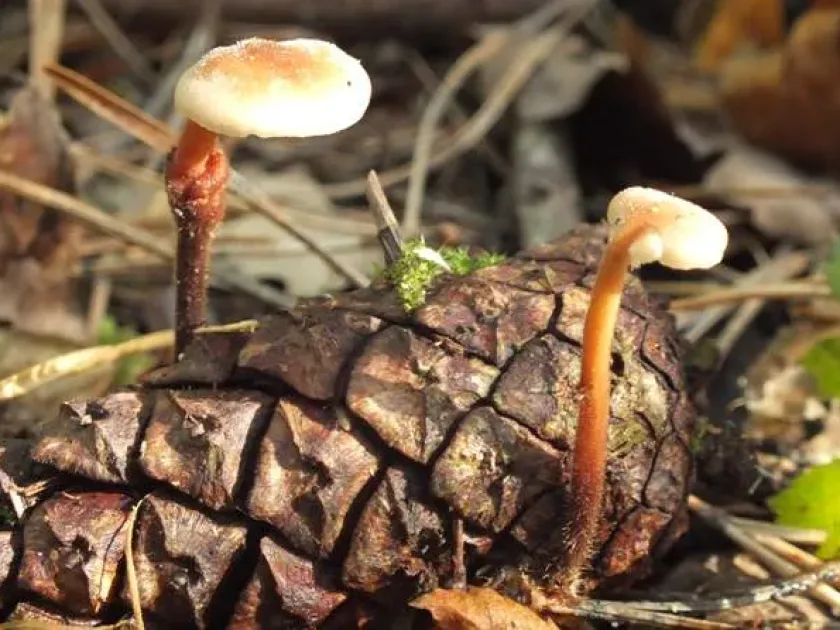
Description
Symptoms
The most prominent sign of its presence is the appearance of small, brown, fan-shaped or kidney-shaped fruit bodies growing out of decaying conifer cones on the forest floor.
The caps are typically 1–3 cm in diameter, often covered with a brownish, fuzzy texture, and are supported by a thin, lateral or eccentric stem that anchors them to the cone.
The hymenium, located on the underside, consists of downward-pointing spines (teeth), which serve to increase the surface area for efficient spore dispersal.
The cones colonized by the fungus often show signs of structural degradation, becoming brittle and disintegrating more rapidly than uncolonized cones in the same environment.
In moist, shaded areas, one may observe clusters of these fungi, as the interconnected mycelium can span across several decomposing cones in the soil.
Pathogen
Auriscalpium vulgare, commonly known as the ear-pick fungus, is a basidiomycete fungus belonging to the family Auriscalpiaceae. It is not a plant pathogen but a specialist saprotroph.
The fungus is ecologically tied to the remains of conifer trees, specifically developing its mycelium within decaying spruce or pine cones that are buried or partially covered in forest litter.
The organism produces distinct fruit bodies that are characterized by a small, hairy cap and a stalk, with the underside of the cap covered in fine spines rather than gills or pores.
Its biological activity involves the secretion of enzymes capable of breaking down lignin and cellulose, which are the main components of the woody scales of fallen cones.
Since it only targets dead organic matter, this fungus is a vital component of the forest floor's decomposition cycle rather than a threat to living plants.
Conditions for development
The ear-pick fungus requires a moist microclimate to flourish. It is most commonly found in damp coniferous or mixed forests with deep layers of needles and shade.
A continuous supply of substrate, specifically fallen and partially decomposed cones, is essential for the development of its fruit bodies during the growing season.
The fungus thrives in cool to moderate temperatures, generally between 10°C and 18°C, and is most active during periods of high humidity in late summer and autumn.
As a forest floor inhabitant, it is sensitive to desiccation and direct sunlight, which is why it prefers areas protected by dense tree canopies and undergrowth.
The acidic soil conditions typical of conifer forests provide the preferred chemical environment for the mycelium to break down the tough materials in the cones.
Why it matters
The fungus is completely harmless to living trees. It does not possess the mechanisms to penetrate healthy plant tissue or cause infections in forest plantations.
There is no economic harm associated with this fungus. It does not affect the health of standing timber, crop yields, or the quality of nursery seedlings.
In fact, it is considered beneficial to forest health because it accelerates the decomposition of woody litter, helping to recycle nutrients back into the soil.
Misidentifying this fungus as a pathogen can lead to unnecessary concerns, but it should be viewed as a sign of a healthy, functioning forest ecosystem.
No agricultural interventions are needed, as its presence does not lead to any degradation of the forest's overall growth or productivity.
Protection
There are no control measures for this fungus, as it is not a pest or disease agent. Managing it is entirely unnecessary and counterproductive to forest health.
For those who find its presence in a garden or nursery undesirable, the simplest and only recommended approach is to remove the fallen cones from the area.
By eliminating the woody substrate, the fungus will naturally cease to produce fruit bodies, as it cannot survive without the specific material it feeds upon.
Chemical fungicides are never recommended, as they can cause significant damage to the soil microbiome and beneficial mycorrhizal networks that trees rely on.
Forestry management should focus on identifying and controlling genuine pathogens, while allowing beneficial saprotrophic fungi to carry out their essential role.
Discussion
No discussions yet — be the first.