
Auriscalpiaceae
Auriscalpiaceae
Description
Symptoms
The primary sign of their presence is the development of small, unique fruiting bodies. These are frequently found on fallen, partially buried coniferous cones in forest litter.
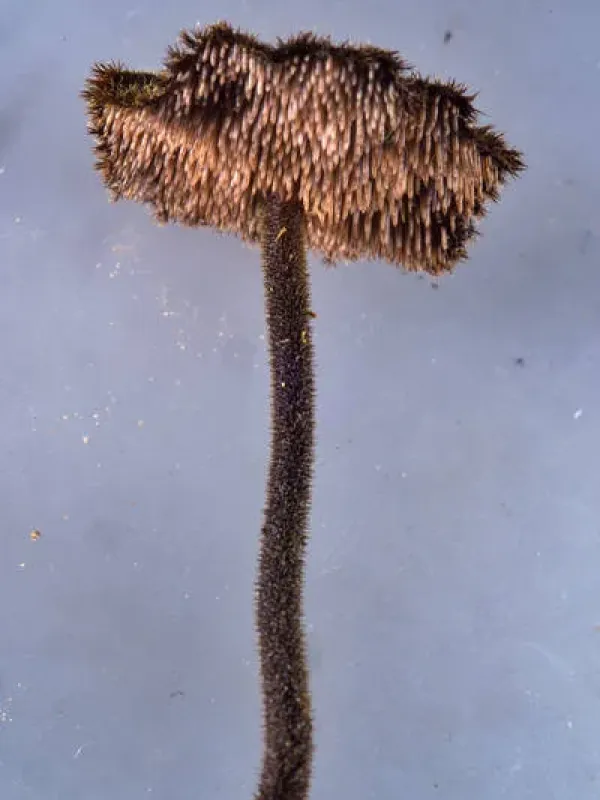
The fruiting bodies are often characterized by a lateral, pubescent stipe and an eccentrically attached pileus. The hymenophore, which is covered in tiny spines, is the most diagnostic feature.
The appearance of these mushrooms is often cryptic due to their dark brown or nearly black color, allowing them to blend seamlessly with the surrounding detritus of the forest floor.
Internally, the colonization of the substrate by the mycelium causes a gradual softening and degradation of the coniferous cones, which may lose their rigid structure over time.
The development of these fungi is usually localized, appearing in small clusters during periods of sufficient moisture in temperate forest zones.
Pathogen
The Auriscalpiaceae (Latin: Auriscalpiaceae) is a family of fungi in the order Russulales. They are predominantly saprotrophic organisms rather than pathogens, and they play a vital ecological role in forest environments.
The type genus, Auriscalpium, is known for its distinct morphology, featuring a pileus and a stipe, with a hymenophore consisting of small, downward-pointing spines. These fungi specialize in decaying woody debris, particularly pine and spruce cones.
In terms of agricultural pathology, these fungi do not infect or damage cultivated plants, vegetables, or crops. They are not considered a threat to agricultural productivity or plant health.
Biologically, they function as decomposers, breaking down complex lignocellulose structures in dead plant matter. This process is essential for nutrient cycling in forest soils.
Their distribution is tied to coniferous habitats where suitable substrate is available. They inhabit the forest floor and participate in the natural processes of organic mineralization.
Conditions for development
The development of Auriscalpiaceae is strictly dependent on specific forest conditions, requiring high humidity and moderate temperatures consistent with forest environments.
A continuous supply of coniferous woody substrate, specifically cones, is necessary for their growth and successful reproduction through spore dispersal.
Soil and air moisture levels play a critical role; these fungi thrive in environments where the organic litter layer remains damp for extended periods during the growing season.
They are sensitive to the chemistry of their environment, preferring the acidic and organic-rich conditions typical of pine and spruce forest soils.
Stable, undisturbed forest habitats provide the best conditions for their mycelial activity, as they do not adapt well to the highly disturbed environments of modern agricultural fields.
Why it matters
Auriscalpiaceae fungi cause no economic damage or harm to agricultural crops. They are ecologically beneficial organisms that do not compete with farmers' crops for space or resources.
There is no risk of these fungi infecting living plant tissue, as their biological specialization is limited to the breakdown of already dead, lignified plant tissues.
They are not considered pests or diseases, and therefore, they do not appear in any agricultural health manuals or quarantine lists for crop protection.
Mistaking these beneficial saprotrophs for plant pathogens may lead to unnecessary chemical treatments, which could inadvertently harm beneficial soil biology.
In short, these fungi are neutral and invisible to agricultural production, remaining confined to their ecological niche within the forest ecosystem.
Protection
No protection measures are necessary, as Auriscalpiaceae are not plant pathogens. They perform a valuable role in nature by accelerating the decomposition of organic debris.
If their presence is undesirable in managed decorative or park areas, simple physical removal of the host material, such as pine cones, will naturally eliminate the population.
The application of fungicides is strongly discouraged, as these chemicals are useless against saprotrophs in this context and could negatively impact soil biodiversity.
Management practices for these fungi are limited to standard landscape maintenance. Keeping garden beds clear of excessive woody debris is sufficient to manage their presence.
Focusing on plant health through proper fertilization and irrigation is a far more effective strategy than worrying about non-pathogenic forest fungi in the vicinity.
Discussion
No discussions yet — be the first.