
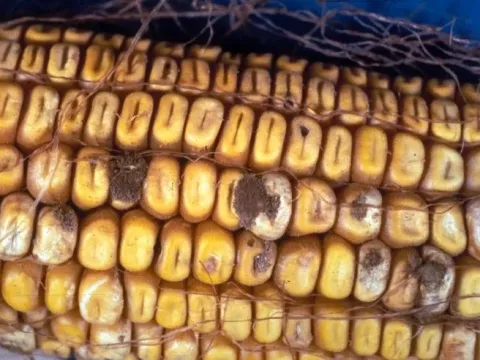
Aspergillus reptans
Aspergillus reptans
The causal agent of this disease is the microscopic fungus Aspergillus reptans, which belongs to the Aspergillus glaucus group. It is a filamentous fungus often found in stored agricultural commodities and sometimes on field crops.
What the section contains
Aspergillus reptans
This fungus is recognized as a xerophilic organism, meaning it thrives in environments with low water activity. It is highly adapted to survive in dry conditions where most other fungal competitors fail to germinate.
Morphologically, A. reptans produces conidiophores that release numerous airborne spores. These spores are remarkably resilient and can persist in soil, crop debris, and storage facility crevices for extended periods.
While often acting as a saprophyte, the fungus can behave as an opportunistic pathogen. It exploits damaged plant tissues or physiological stress in crops to establish infection.
The biological success of A. reptans is linked to its ability to colonize various substrates. It is a persistent pathogen that requires specific environmental management to control effectively in an agricultural setting.
The primary factor facilitating the growth of Aspergillus reptans is the moisture content of the substrate. Although it prefers lower humidity, a slight increase in water activity triggers rapid fungal development.
In storage environments, poor ventilation is the main driver of outbreaks. Stagnant air allows for moisture pockets to form, creating ideal micro-environments for the fungus to proliferate.
Field infection occurs primarily when plant tissues are weakened or mechanically damaged. Weather-related issues, such as rain during the grain-filling stage, can also increase the susceptibility of the crop.
The presence of physical impurities and damaged seeds in bulk storage accelerates the spread of A. reptans. These impurities act as initial food sources for the fungus before it moves to healthy kernels.
High temperatures combined with improper moisture management create an ideal synergy for the pathogen to spread throughout the grain mass, often leading to localized heating.
The most significant impact of Aspergillus reptans is the degradation of grain quality. Infected seeds exhibit significantly lower germination rates, making them unsuitable for planting.
The metabolic activity of the fungus results in the production of mycotoxins. These toxic compounds pose severe health risks to humans and livestock if the contaminated grain enters the food chain.
During the colonization process, the fungus produces enzymes that break down proteins and starch. This leads to a loss of nutritional value and a distinct, unpleasant musty odor in the product.
In field conditions, severe infection manifests as a black discoloration on the heads of cereals. This reduces the overall yield as seeds become shriveled and lightweight.
Beyond the direct yield loss, the risk of heating and spontaneous combustion in poorly managed grain piles represents a major economic and physical danger to storage facilities.
The most effective strategy for controlling A. reptans is maintaining strict moisture levels during storage. Grain must be dried to below 12-13% moisture to inhibit fungal growth.
Sanitation of storage facilities is crucial. Regularly cleaning bins and using approved antifungal treatments helps in reducing the initial spore load before the harvest is stored.
In the field, applying preventative fungicides during critical growth stages—especially during grain filling in humid weather—can protect the crop from initial colonization.
Adopting good agricultural practices, such as proper crop rotation and the removal of crop residues, helps lower the overall inoculum level in the field environment.
- Thorough grain drying
- Active aeration systems in bins
- Strict temperature monitoring
- Fungicide applications during high-risk seasons
- Rigorous cleaning of grain to remove dust and debris