
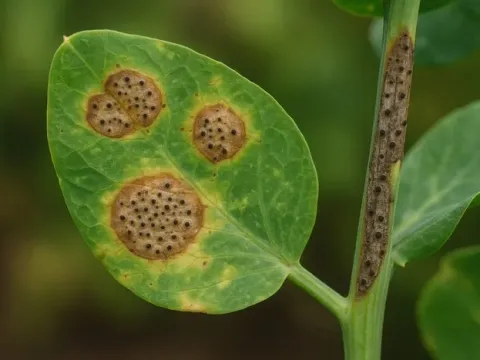
Ascochyta blight
Ascochyta fabae
The causal agent of this disease is the fungus Ascochyta fabae, an imperfect fungus that specifically targets various legume crops. It represents a significant threat to pulse production globally due to its efficient survival and dissemination mechanisms.
What the section contains
Ascochyta blight
The fungus overwinters primarily in infected plant debris left in the field and within contaminated seed coats. This dual-source infection capability allows the pathogen to persist in soil for several years and travel across long distances via seed trade.
During the growing season, the pathogen produces conidia within small, flask-shaped structures called pycnidia. These spores are released during wet weather and dispersed by rain splashes, wind, and irrigation, leading to secondary infection cycles.
Biological development of the fungus is characterized by its ability to infect all above-ground plant parts. The hyphae penetrate plant tissue, secrete enzymes that dissolve cell walls, and colonize the host, leading to visible necrosis within a few days.
The longevity of Ascochyta fabae in the soil is supported by its ability to remain dormant within decomposing plant tissues until the environmental conditions trigger spore production. This makes crop rotation an essential component of management.
The primary symptoms appear as irregular or circular spots on leaves, stems, and pods. These lesions typically exhibit light-colored centers with a distinct, darker brown or purplish margin, making them easily identifiable in the field.
As the lesion matures, tiny black dots called pycnidia appear in the center of the spots, often arranged in concentric circles. These pycnidia are the hallmark of Ascochyta species and are vital for field diagnosis.
Stem lesions are particularly damaging as they can become sunken and girdle the stem. This often results in the collapse of the plant and the death of the upper foliage due to restricted nutrient and water transport.
Pods infected with the fungus develop sunken, dark spots. These lesions often extend through the pod wall into the developing seeds, causing discoloration, shriveling, or the appearance of necrotic spots on the seed surface.
Seedlings emerging from infected seeds may show brown necrotic lesions on the cotyledons or hypocotyl. In severe cases, the infection causes pre-emergence damping-off, leading to sparse and uneven plant stands.
Ascochyta blight thrives in cool, wet weather conditions. The pathogen is most active at temperatures ranging from 15°C to 25°C, coupled with high humidity or frequent rainfall, which are critical for spore germination and infection.
Dense crop canopies increase the risk of infection by maintaining high humidity levels near the soil surface and reducing airflow. This microclimate promotes the rapid spread of spores from the lower canopy to the upper parts of the plant.
Continuous rainfall or heavy dew provides the necessary moisture for the conidia to germinate and penetrate the epidermis of the plant. Periods of drought significantly restrict the disease progress, but the pathogen persists in the tissue.
Poor field management, including the failure to bury crop residues, allows the inoculum to remain on the surface, increasing the potential for early-season outbreaks. Continuous cropping of legumes on the same land facilitates inoculum buildup.
Stress factors such as mechanical damage, insect feeding, or herbicide injury can make the crop more susceptible to penetration by the fungus. Healthy, vigorous plants are more resilient to the initial stages of the infection.
The economic impact of Ascochyta blight is substantial, often resulting in significant yield losses ranging from 20% to 50% under epidemic conditions. Both the quantity and the nutritional quality of the pulses are severely compromised.
Premature leaf drop and pod loss reduce the photosynthetic area, causing poor grain filling and producing small, shriveled seeds. This significantly affects the marketability and grade of the harvested product.
Infected seed lots exhibit reduced germination rates and poor seedling vigor, which complicates crop establishment. Using such seeds without proper fungicidal treatment leads to the spread of the disease to previously clean areas.
Stem breakage due to girdling lesions makes the crop difficult to harvest, causing high mechanical losses during the combine process. This forces farmers to incur additional costs for harvesting and cleaning the grain.
In cases of severe infestation, the grain may contain mycotoxins, rendering it unsuitable for human consumption or animal feed. This limits the end-use options and reduces the total value of the production.
The cornerstone of control is the use of high-quality, certified, and disease-free seeds. Seed treatment with systemic fungicides is necessary to eliminate seed-borne inoculum and protect the emerging seedlings.
Crop rotation is essential to break the life cycle of the pathogen. A break of at least 3 to 4 years between legume crops is recommended, alongside the spatial isolation of current fields from previous sites.
Deep plowing or incorporation of crop residues into the soil helps accelerate the decomposition of infected material, effectively reducing the primary inoculum level for the next season.
Foliar application of fungicides is crucial during the growing season to prevent epidemic development. The most effective window for application is during the bud formation and early flowering stages.
- Selecting resistant or tolerant cultivars
- Implementing wide row spacing to improve canopy aeration
- Controlling weeds that may harbor the fungus
- Optimizing nitrogen and potassium fertilization for crop vigor