
Ascochyta blight of pea
Didymella pinodes
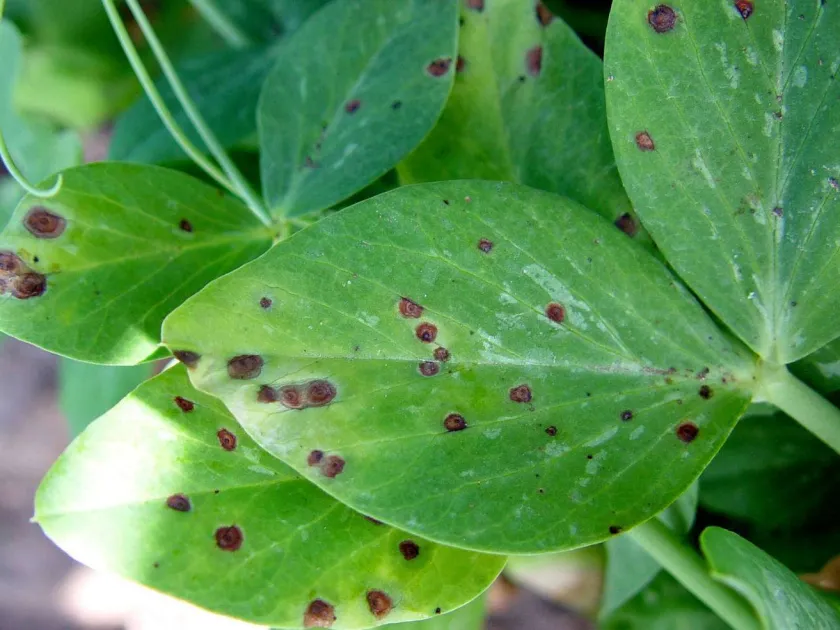
Description
Symptoms
The first signs of infection appear on seedlings as brown spots on the cotyledons and the root neck. This often leads to the death of young plants.
On leaves and stipules, circular brown spots form with a darker edge and a lighter center. Over time, the spots merge, causing the leaf blade to dry out.
On stems, the symptoms appear as elongated dark brown spots, which, in severe cases, can cover the entire stem, leading to breakage.
Infection of pods manifests as sunken spots with black dots — the pycnidia of the fungus. Seeds inside such pods are often shriveled, wrinkled, and infected with the pathogen.
In high humidity, a gray or brown coating of conidial sporulation is visible on the affected areas, which serves as a diagnostic feature.
Pathogen
The causal agent of the disease is the fungus Didymella pinodes (anamorph Ascochyta pinodes). This ascomycete fungus affects all aerial parts of the plant throughout its growing season.
The infection survives in soil on crop residues and is also transmitted through infected seeds. The fungus can persist for long periods in the form of pycnidia and perithecia.
In the development cycle, ascospores play a crucial role; they are spread by wind over long distances and cause mass primary infection of the crops.
The mycelium of the fungus penetrates plant tissues, destroying their structure. During development, the pathogen forms pycnidia, which ensure secondary dispersal of conidia during the season.
The disease is a typical representative of fungal pathogens that prefer humid environments for successful spore germination and colonization of pea tissues.
Conditions for development
The main factor for the spread of Ascochyta blight is high humidity (above 80%) and frequent rainfall during the crop's growing season.
The optimal temperature for intense fungal growth ranges from +20 to +25 degrees Celsius, although infection is possible at lower temperatures as well.
Dense crop stands, which contribute to moisture stagnation in the ground layer, create ideal microclimatic conditions for the rapid development of an epidemic.
The presence of large amounts of undecomposed crop residues from the previous year significantly increases the infection pressure and the risk of early infection.
Weeds from the legume family can act as an additional reservoir of infection, maintaining the viability of the fungus in the absence of the main crop.
Why it matters
Ascochyta blight causes serious damage to crop yields, reducing the total grain weight and its quality. Infected seeds have low germination rates and seedling vigor.
The disease leads to premature aging and the death of leaves, which critically reduces the photosynthetic activity of the plant during the pod formation period.
The damage manifests as lodging of stems due to tissue destruction, which makes mechanical harvesting extremely difficult and leads to additional losses.
With severe development of the disease, grain yield losses in peas can reach 30-50% depending on weather conditions and the phase of epidemic onset.
Infected seeds may be toxic or unsuitable for feed due to the accumulation of mycotoxins released by the fungus during its life cycle.
Protection
The foundation of protection is the use of healthy, certified seed material free from pathogens and the treatment of seeds with fungicides.
Crop rotation is necessary, with a return of peas to the same field only after 4-5 years to reduce the accumulation of infection in the soil.
Deep plowing of the soil contributes to the accelerated decomposition of crop residues, which are the main source of fungal survival during the winter period.
Applying fungicides during the growing season, especially in the budding and early flowering phases, allows for effective containment of disease spread throughout the field.
- Spatial isolation from previous year's pea fields.
- Balanced application of phosphorus and potassium fertilizers to boost plant immunity.
- Timely control of weeds that act as infection reservoirs.
- Cultivation of resistant varieties if available in regional breeding programs.
Discussion
No discussions yet — be the first.