
Anisomeridium biforme
Anisomeridium biforme
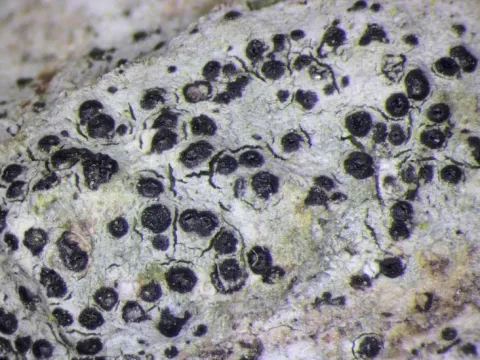
Anisomeridium biforme is an epiphytic lichen that colonizes the bark of various woody plants, appearing as a crust-like growth.
What the section contains
Anisomeridium biforme
It manifests as small, rounded patches that can expand over time and eventually merge to cover large areas of the trunk or branches.
The color of the thallus is typically greyish or olive-green, blending naturally with the texture of the tree bark.
Tiny black fruiting bodies, known as perithecia, are embedded within the bark surface and serve as a diagnostic feature of this organism.
While the initial colonization is subtle, dense growth can give the bark a roughened or granular appearance over several seasons.
The agent Anisomeridium biforme is a lichenized fungus belonging to the Ascomycota division, living in symbiosis with algal cells.
As an epiphyte, it does not derive nutrients directly from the tree's living tissues, but rather uses the bark solely as a physical substrate.
The fungus produces spores that are primarily dispersed by wind and rain, allowing it to colonize adjacent trees within a forest or orchard.
Its biological cycle is well-adapted to surviving on woody surfaces, resisting fluctuations in temperature and periods of dryness.
Although not a parasitic pathogen in the traditional sense, its lifecycle is inextricably linked to the host's bark environment.
The development of this lichen is highly favored by high ambient humidity and frequent precipitation throughout the growing season.
Shaded environments, such as dense orchards or wooded areas with poor sunlight penetration, are ideal for its establishment.
Older trees with slow-growing, rugged bark provide more stable surfaces for colonization compared to young, smooth-barked saplings.
Poor airflow within the canopy prevents rapid evaporation of moisture, creating a persistent microclimate that supports spore germination.
Neglecting tree hygiene and allowing bark debris to accumulate can further promote the proliferation of this epiphytic fungus.
While not a primary killer of trees, Anisomeridium biforme can have indirect detrimental effects when colonization becomes excessive.
The dense layer of lichen can obstruct the natural gas exchange of the bark, potentially stressing the underlying vascular tissues.
Persistent moisture held by the lichen provides a haven for harmful insect pests like scale insects or mites that damage the bark.
Continuous damp conditions under the thallus increase the risk of secondary infections by more aggressive fungi or bacteria.
Significant coverage is often a symptom of an already weakened tree, reflecting low vigor and a lack of proper orchard maintenance.
Physical removal through gentle scraping of the affected bark during the dormant season is the most direct and effective control method.
Applying a horticultural lime wash to tree trunks helps alter the pH of the surface, making it inhospitable for lichen growth.
Proper pruning practices that open the canopy to sunlight and air circulation are essential for discouraging long-term establishment.
Copper-based fungicides can be used as a treatment to reduce the density of lichen growth and eliminate fungal spores on the bark.
Maintaining overall tree vitality through proper fertilization and watering reduces the likelihood of the tree becoming a target for colonization.