
Annosus root rot
Heterobasidion irregulare
Description
Symptoms
Visible symptoms often start with the yellowing and thinning of the canopy. Over time, the needles become reddish-brown and fall prematurely, signaling significant root failure.
A thorough inspection of the root collar may reveal white mycelial mats beneath the bark or within cracks, indicating active fungal growth and tissue decay.
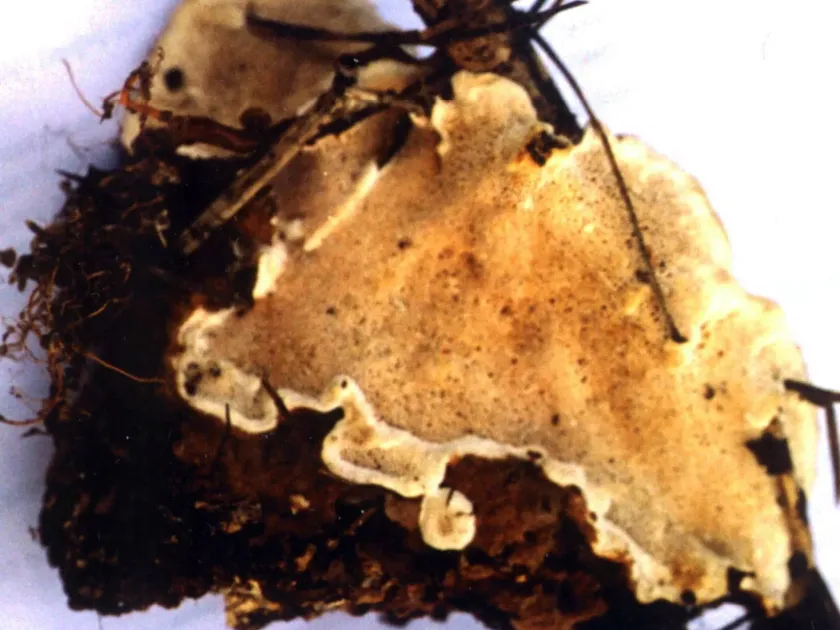
Fruiting bodies of the fungus frequently emerge at the base of infected trees or on stumps. They typically appear as leathery, shelf-like structures with a brown top and a creamy-white pore surface.
Internal wood inspection confirms the presence of characteristic decay. Initial stages show a reddish or violet discoloration, which eventually progresses into white pocket rot with black flecks.
Increased wind-throw in a stand is a major indicator of root decay. Because the roots lose their structural strength, trees are easily toppled by wind, even before they show severe canopy dieback.
Pathogen
The disease is caused by the pathogenic fungus Heterobasidion irregulare, a destructive basidiomycete. This pathogen specifically targets coniferous tree species, invading their root systems and causing severe heart rot.
The fungus acts as a parasite, entering healthy trees through fresh stump surfaces or wounds in the roots or bark. Once inside, it develops a mycelium that systematically breaks down the wood structure.
Its life cycle relies heavily on basidiospores, which are spread by wind currents. These spores settle on exposed wood surfaces, such as logging stumps, initiating new infection sites.
Transmission also occurs vegetatively through root contacts between neighboring trees. This mechanism allows the fungus to spread underground, creating large expanding pockets of infection within a stand.
The pathogen is highly persistent, capable of surviving in dead roots and stumps for several decades, which complicates long-term management and reforestation efforts.
Conditions for development
Annosus root rot thrives in various soil types, particularly in sandy or well-drained soils that allow for easier mycelial movement through root systems.
Optimal environmental conditions include high humidity and moderate temperatures, which favor both spore germination and the rapid expansion of the fungus.
Human activities, especially logging and thinning operations, significantly increase infection risk by creating fresh wounds on roots and exposing stump surfaces to airborne spores.
High-density plantations create a conducive environment for root grafting, which acts as a highway for the fungus to move from an infected tree to a healthy neighbor.
Poor site management that leaves stumps behind serves as a long-term reservoir for the pathogen, sustaining its presence in the soil for future generations of trees.
Why it matters
The primary damage includes widespread mortality of conifers, leading to significant economic losses and a decrease in timber production volume and quality.
Infected wood loses its mechanical integrity, making it unusable for most industrial or construction purposes, thus severely devaluing the harvested lumber.
The disease creates gaps in the forest canopy, disrupting the stand structure and forcing expensive restoration and reforestation activities for landowners.
Increased susceptibility to wind-throw and subsequent secondary pest attacks, like bark beetles, can lead to the total collapse of forest ecosystems.
Long-term soil contamination makes it difficult to replant coniferous species on the same site without incurring significant future losses.
Protection
The most effective preventive measure is the application of biocontrol agents, such as Phlebiopsis gigantea, to freshly cut stumps immediately after logging to inhibit spore colonization.
Forest managers should implement careful harvesting techniques to minimize root injuries to standing trees, thereby reducing the chances of pathogen entry.
Promoting diverse forest stands by mixing conifers with deciduous species can naturally slow down the spread of the fungus, as it is less effective at attacking broadleaf trees.
Sanitation efforts, including the removal of infected trees and their root systems in specific focal points, help to contain the spread and protect adjacent healthy stands.
- Stump treatment with biocontrol fungi.
- Reduction of mechanical root injury.
- Planting of mixed-species forests.
- Systematic removal of infected trees.
- Monitoring of forest health indicators.
Discussion
No discussions yet — be the first.