
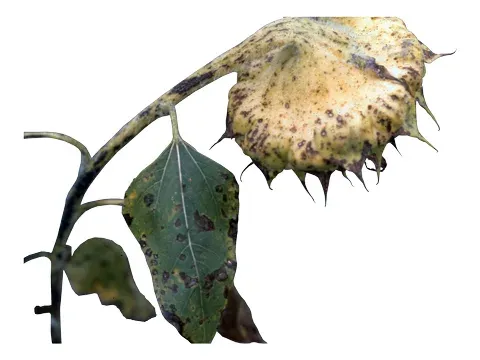
Alternaria leaf spot of sunflower
Alternariaster helianthi
The causative agent of the disease is the fungus Alternariaster helianthi (previously known as Alternaria helianthi). It is a necrotrophic pathogen that primarily affects the Asteraceae family, with sunflower being its most susceptible host.
What the section contains
Alternaria leaf spot of sunflower
The fungus survives the winter as mycelium and conidia in infected crop residues, soil, and occasionally on seeds. The ability of the pathogen to persist in the field for several years makes it a major challenge for traditional crop rotation.
Primary infection occurs in the spring when conidia are dispersed by wind or splashing rain onto the lower leaves of the plants. The pathogen thrives under warm and humid conditions, completing multiple infection cycles during a single growing season.
Pathogenicity is facilitated by the fungus's ability to produce large amounts of conidia, which can travel long distances to infect healthy plants. This rapid spread is characteristic of severe epidemics.
Biological research indicates that different strains of A. helianthi vary in virulence, which explains why certain sunflower hybrids may show different levels of resistance across different geographic regions.
Initial symptoms of Alternaria leaf spot appear as small, circular, dark brown to black spots on the leaves. These spots are often surrounded by a chlorotic (yellow) halo, which is a classic diagnostic feature.
As the disease progresses, these lesions expand and coalesce, leading to large areas of necrotic tissue. Eventually, the leaves wither and dry out prematurely, which significantly impairs the plant's photosynthetic capacity.
Stem lesions occur as dark, elongated, sunken streaks or spots. If these lesions grow large enough, they can weaken the structural integrity of the stem, resulting in lodging or stem breakage during high winds.
In cases of severe infection, the disease can affect the back of the sunflower head, causing necrotic patches. This can penetrate the head, leading to internal decay and reduced quality of the seeds.
Under humid conditions, a dark, velvety layer of fungal spores may be visible on the necrotic spots. This layer is a reliable indicator of the presence of the pathogen when examining the plant in the field.
The development and spread of Alternaria leaf spot are highly dependent on warm temperatures (between 20°C and 30°C) and consistent moisture. Rainy weather and high humidity are the primary catalysts for outbreaks.
Persistent leaf wetness, often caused by fog or heavy dew, provides the necessary environment for the conidia to germinate and penetrate the leaf epidermis. The fungus effectively utilizes these moisture-rich periods to multiply.
Crowded planting schemes that restrict air circulation create a microclimate that remains moist for longer durations. This environment is highly conducive to the proliferation of A. helianthi.
Poor agricultural practices, such as minimal tillage or leaving heavy plant residue on the soil surface, provide a continuous source of inoculum for subsequent seasons. This accumulation of infected biomass is a major driver of disease severity.
Sunflower plants subjected to environmental stress, nutrient deficiencies, or pest attacks become significantly more susceptible. Their weakened state makes it easier for the fungus to establish infection and colonize host tissues.
The primary economic impact of the disease is a significant loss in seed yield. By destroying leaf area, the fungus reduces the plant's ability to fill the sunflower head, resulting in smaller, lighter seeds.
The disease also has a detrimental effect on oil content and overall seed quality. Seeds from heavily infected plants are often of lower market value due to reduced oil percentage and increased levels of impurities.
Yield losses can reach up to 50 percent under favorable conditions for the pathogen. Premature senescence induced by the fungus prevents the plant from reaching its full physiological potential.
Stem breakage caused by necrotic lesions leads to direct harvest losses. Sunflowers that have fallen over are difficult for machinery to pick up, resulting in significant portions of the crop being left in the field.
The pathogen can also be seed-borne, meaning that infected seeds can transfer the disease to new planting areas, potentially introducing the problem into fields where it was previously not present.
A rigorous crop rotation strategy is the most effective cultural control measure. Planting sunflowers in the same field no more than once every four to five years helps to break the disease cycle and reduce the soil-borne inoculum.
Deep plowing to bury crop residues is highly recommended to accelerate the decomposition of infected tissues. Additionally, using certified, disease-free seed is crucial to prevent early-season infections.
- Monitor fields regularly for early symptoms.
- Control weeds that may act as alternative hosts.
- Maintain optimal plant spacing to promote airflow.
- Use fungicides during critical growth stages.
Chemical control involving systemic fungicides (such as triazoles or strobilurins) is effective when applied as a preventative measure or at the very onset of disease symptoms. Timely application is key to preventing widespread outbreaks.
Integrated Pest Management (IPM) practices, including the selection of resistant hybrids and balanced fertilization, are essential for maintaining crop health and minimizing the risk of severe damage from A. helianthi.