
Potato purple-top
Potato purple-top
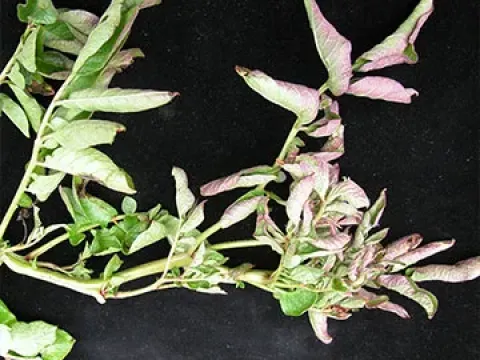
The primary visual symptom of potato purple-top is the chlorosis and upward rolling of the upper leaflets, which often become rigid and brittle.
What the section contains
Potato purple-top
Leaves often develop a distinct purple or reddish-pink discoloration along the margins, which is a hallmark of this phytoplasma infection.
Infected plants exhibit shortened internodes, leading to a stunted and bushy growth habit that clearly distinguishes them from healthy plants.
The underground development of the plant is significantly impaired, often resulting in few tubers, aerial tubers, or small, malformed, and flaccid tubers.
Internal examination of infected tubers frequently reveals vascular necrosis, which makes them unsuitable for storage and renders them low-quality for processing.
Potato purple-top is caused by phytoplasmas, which are specialized, wall-less bacteria that inhabit the phloem tissue of susceptible host plants.
The disease is systemic, meaning the pathogen moves throughout the vascular system, effectively hijacking the plant's metabolic and transport processes.
Transmission occurs exclusively through insect vectors, primarily leafhoppers, which acquire the phytoplasma while feeding on infected plant phloem.
Once an insect acquires the phytoplasma, it typically undergoes a latent period before becoming infectious, after which it can transmit the disease for the rest of its life.
Unlike some viruses, the phytoplasma is not mechanically transmitted via pruning tools or general plant-to-plant contact in the field environment.
The development of purple-top outbreaks is highly correlated with the migration patterns and population density of leafhopper vectors in the vicinity.
Hot, dry weather conditions provide ideal circumstances for the rapid multiplication and increased mobility of the insect vectors carrying the pathogen.
Weed hosts, especially perennial species, serve as essential overwintering reservoirs for both the phytoplasma and the vectors, facilitating early-season infection.
Proximity to unmanaged fields or areas with high weed pressure increases the probability of vector movement into potato fields throughout the growing season.
Agricultural mismanagement, such as poor weed control on field margins and neglecting to monitor insect populations, drastically exacerbates the disease pressure.
The disease is highly destructive as it disrupts the translocation of photoassimilates, leading to significant reductions in tuber yield and quality.
Tubers produced by infected plants are often of poor quality, exhibiting structural abnormalities that make them unfit for commercial sale or consumption.
Because the disease causes systemic infection, tubers from symptomatic plants should never be used as seed, as they will propagate the infection to new crops.
In cases of severe outbreaks, farmers may face total crop loss, resulting in significant economic damage and reduced farm productivity.
The disease also negatively impacts the storage potential of the harvest, as internal vascular necrosis encourages secondary rot and rapid decay during storage.
The most effective management strategy involves the rigorous control of leafhopper populations using well-timed applications of systemic insecticides.
Implementing strict sanitation practices, including the removal and destruction of symptomatic plants, is crucial to reduce the primary inoculum source.
Managing field margins and neighboring areas to control weeds that host both the pathogen and the insect vectors is vital for long-term prevention.
Farmers are strongly advised to purchase certified, disease-free seed potatoes and avoid using tubers sourced from fields where purple-top was detected.
- Utilizing crop rotation with non-host species to break the disease cycle.
- Monitoring insect populations using yellow sticky traps to inform spray decisions.
- Choosing potato varieties that show natural tolerance or resistance to phytoplasma infections.