
Potato Pectobacterium parmentieri
Pectobacterium parmentieri
Pectobacterium parmentieri is a gram-negative, rod-shaped bacterium that acts as a significant plant pathogen, primarily causing soft rot in potato tubers and stems.
What the section contains
Potato Pectobacterium parmentieri
Belonging to the family Pectobacteriaceae, this pathogen is characterized by its production of pectolytic enzymes that break down the middle lamellae of plant cells, leading to tissue degradation.
The bacterium is known for its ability to persist in diverse environments, including soil, contaminated seed tubers, and organic debris left in the field after harvest.
Unlike some other soil-borne pathogens, P. parmentieri can survive in the vascular system of the plant, often remaining latent until environmental conditions trigger its activation.
The pathogen is highly opportunistic, and its virulence is often enhanced when it interacts with other members of the Pectobacterium or Dickeya genera in mixed infections.
In the field, the first signs of the disease are often wilting of the upper leaves, followed by chlorosis and potential stunting of the plant growth.
The stems of affected plants often show signs of water-soaking and softening near the base, which eventually turns dark brown or black as the tissue collapses.
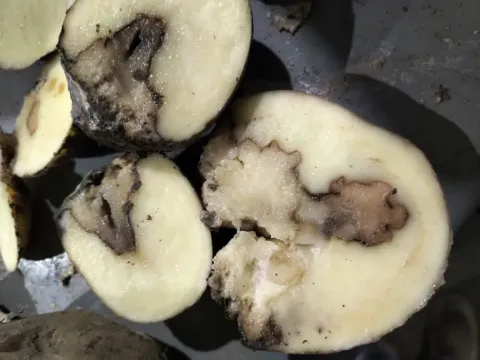
Tubers exhibit the most diagnostic symptoms: localized soft spots that are moist and mushy, which can expand rapidly throughout the entire tuber under favorable conditions.
The decaying tissue typically produces a strong, offensive odor, and in moist conditions, the outer surface of the tuber may become slimy due to bacterial ooze.
- Wilting and chlorosis of foliage.
- Blackleg symptoms on stems.
- Rapid softening of tubers.
- Foul-smelling tissue degradation.
- Formation of slimy bacterial ooze.
The development of Pectobacterium parmentieri is heavily dependent on moisture levels. Waterlogged or poorly drained soils significantly favor bacterial multiplication.
The pathogen thrives in moderate temperature ranges, typically between 20°C and 25°C, though it remains capable of causing damage at lower temperatures during storage.
Poor aeration in the soil restricts oxygen availability, which creates the anaerobic micro-environments necessary for the rapid spread of the bacteria.
Injury to the tubers during harvest serves as the primary entry point for the bacteria. Wet harvest conditions exacerbate the risk of infection significantly.
Improper storage management, such as the accumulation of condensation or lack of airflow, provides the perfect conditions for the disease to spread from infected to healthy tubers.
The economic impact of this pathogen is substantial, as infected tubers are often completely unsalable and unsuitable for processing due to tissue liquefaction.
In field settings, the disease causes premature senescence and plant death, resulting in significant yield loss before harvest time even arrives.
The potential for post-harvest loss is particularly high, as the pathogen can spread through piles of tubers, leading to catastrophic storage rot scenarios.
The presence of this bacteria in fields can complicate future cropping choices, as the pathogen becomes established in the local environment and persists over time.
Control is challenging because once the bacteria have entered the plant tissue, systemic treatments are largely ineffective, leaving growers with few reactive options.
Integrated pest management is essential, beginning with the use of certified, disease-free seed potatoes to minimize the introduction of the pathogen.
Crop rotation remains a fundamental strategy, with recommended intervals of at least three years, avoiding other susceptible solanaceous crops in the rotation cycle.
Minimizing mechanical damage during harvest and ensuring that potatoes are properly dried and cured before storage are critical for preventing soft rot development.
Strict sanitation protocols for equipment, storage facilities, and crates are necessary to eliminate bacterial residues that might survive from one season to the next.
Controlling insect pests, particularly those that feed on stems or tubers, is vital as they can act as vectors for the bacteria, spreading the disease within the crop canopy.