
Potato blackleg
Pectobacterium brasiliense
Description
Symptoms
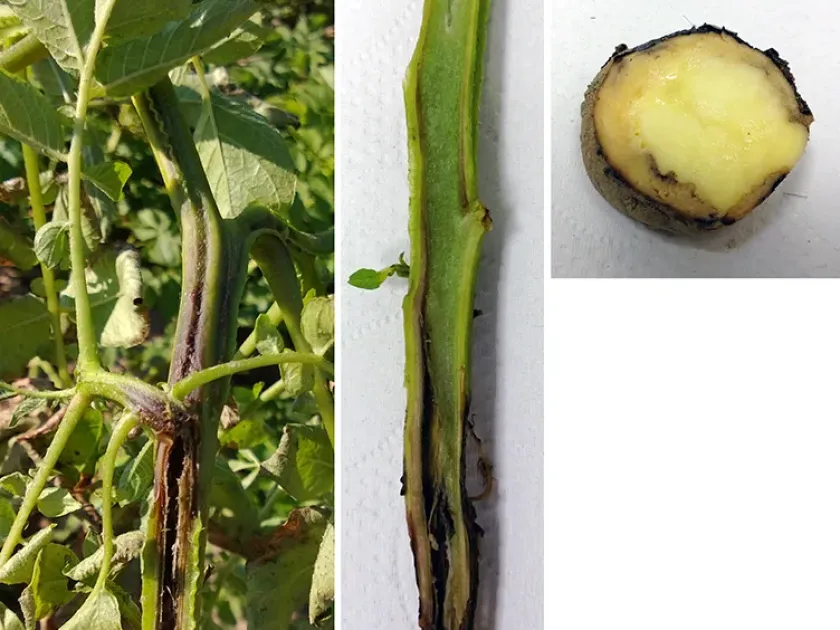
Initial symptoms of the disease are often observed in young shoots. The base of the stem turns dark brown or black, tissues soften and decay, leading to the lodging and eventual death of the plant.
Leaves of infected plants eventually turn yellow, curl along the edges, and become stiff. When trying to pull the stem from the soil, it separates easily from the tuber because the underground part is completely destroyed by rot.
On the tubers themselves, symptoms appear as surface or deep dark spots. When cutting an infected tuber, you can see that the inner part has turned into a mushy mass with a specific pungent, unpleasant odor.
In high humidity conditions, a characteristic slimy coating may appear around the affected stem areas. Damage to the vascular system leads to general plant stunting, causing it to lag behind healthy neighbors in growth.
It is important to distinguish the early stages of the disease: a darkening of the vascular ring is often noticeable on the tuber cross-section, which gradually progresses into extensive necrosis covering the entire flesh.
Pathogen
The causative agent of the disease is the bacterium Pectobacterium brasiliense, which belongs to the soft rot group. It is a Gram-negative, rod-shaped, highly motile bacterium.
The microorganism produces pectinase enzymes, which are capable of efficiently destroying the cell walls of plant tissues. This leads to the loss of structural integrity and rapid conversion of tissues into slime.
The bacterium can persist in plant debris, in the soil, and in infected seed material. It is easily transmitted by insect pests such as potato tuber moths or wireworms.
Pectobacterium brasiliense has a wide host range, including vegetables of the Solanaceae and Brassicaceae families. The pathogen's aggressiveness is due to its ability to quickly adapt to various environmental conditions.
Unlike other pectobacteria, this strain exhibits high pathogenicity at higher temperatures, making it extremely dangerous during periods of active potato growth.
Conditions for development
Development of the disease is favored by high soil and air humidity, especially in combination with moderate to warm temperatures. Excessive moisture creates a favorable environment for bacterial multiplication.
The temperature range from +20 to +28 degrees Celsius is optimal for the rapid spread of the pathogen within plant tissues. Under these conditions, the incubation period is reduced to a few days.
Heavy, poorly aerated soils significantly increase the risk of infection, as moisture often stagnates in them. Oxygen deficiency in the root zone promotes the transition of bacteria into an active phase.
Mechanical damage to tubers and stems during agricultural activities creates entry points for the infection. Bacteria penetrate deep into tissues through wounds, bypassing natural protective barriers.
Improper potato storage, accompanied by moisture condensation and poor ventilation, leads to mass spread of rot in piles and storage facilities.
Why it matters
Blackleg can lead to the complete loss of crops at early growth stages, resulting in significant thinning of plantings and a drastic reduction in yield.
The disease causes not only the death of the foliage but also massive rotting of tubers in the soil, making them unsuitable for food or future seed use.
Produce infected with the pathogen is susceptible to secondary infections, which quickly leads to the transformation of the entire potato batch into a rotten mass during storage.
Farms incur huge economic losses due to the need for unscheduled disinfection, costs of sorting the harvest, and the inability to sell the affected produce.
Infested plots become permanent sources of infection, preventing the cultivation of potatoes and other susceptible crops for several years.
Protection
The primary method of control is the use of high-quality, healthy seed material free from latent infection. Conducting phytosanitary monitoring of plantings is key to success.
Adherence to crop rotation, where potatoes are returned to the same field no earlier than 3-4 years, helps reduce the concentration of bacteria in the soil.
- Seed tuber treatment with specialized products before planting.
- Timely removal and destruction of diseased plants from the field, including the surrounding soil.
- Control of insect pests that serve as vectors for the infection.
- Ensuring optimal drying conditions for tubers after harvest before storage.
It is important to disinfect agricultural equipment and containers after each contact with suspicious plants to prevent further spread of the pathogen.
Upon detecting the first signs of the disease in storage, it is necessary to immediately isolate the focus and improve ventilation to lower the humidity level.
Discussion
No discussions yet — be the first.