
Potato blackleg
Dickeya solani
The causative agent of the disease is the gram-negative bacterium Dickeya solani, belonging to the Pectobacteriaceae family. It is a highly aggressive pathogen that degrades plant tissues by producing a complex array of enzymes that dissolve pectin in cell walls.
What the section contains
Potato blackleg
Unlike Pectobacterium atrosepticum, Dickeya solani is noted for its superior virulence and its ability to infect potato plants under a wider range of environmental conditions, including cooler temperatures.
The bacterium can persist for long periods in infested soil, plant debris, and on the surface of seed tubers, representing a major risk for high-quality potato seed production systems.
Transmission occurs primarily through infected seed tubers, but the pathogen is also easily spread mechanically via farm machinery, handling, or contaminated irrigation water.
The bacterium is motile, equipped with flagella that allow it to migrate through soil moisture toward the roots and stolons of healthy plants, effectively initiating a new infection cycle.
Initial symptoms often manifest as chlorosis and wilting of the upper leaves, which can be misdiagnosed as drought stress or nutrient deficiency in early stages.
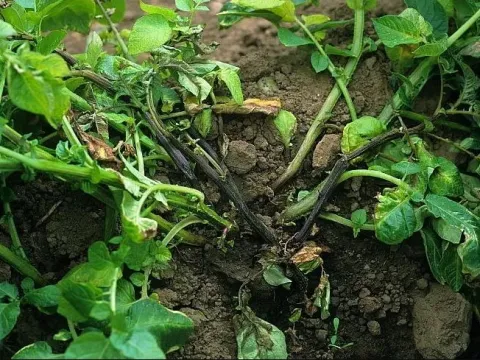
Closer examination reveals a characteristic black, soft, and necrotic lesion spreading from the seed tuber upward through the stem, causing the tissue to become mushy and discolored.
The stems of infected plants show vascular browning and decay of the pith, which turns into a slimy, foul-smelling substance due to the breakdown of internal structures.
The root system of diseased plants becomes weak, fragile, and darkened, causing the entire plant to detach easily from the underground stem if pulled from the soil.
In the field, infected plants appear stunted and weak, often wilting during hot afternoon hours and ultimately collapsing and dying, leaving gaps in the crop stand.
The development of Dickeya solani is favored by high soil moisture and moderate temperatures, which create an optimal environment for rapid bacterial multiplication.
Heavy rainfall or excessive irrigation during the growing season facilitates the movement of the bacteria from the decaying mother tuber to the stems and developing tubers.
Injuries to tubers or stems, whether caused by insect feeding or mechanical handling during cultivation, significantly increase the risk of infection as they provide easy entry points.
Planting non-conditioned or poorly dried seed tubers that harbor latent infections is the most significant factor leading to severe field outbreaks.
Soil compaction, which leads to poor aeration in the root zone, promotes anaerobic conditions that accelerate the softening and decay process within the plant tissues.
The main danger is the pathogen's ability to cause total crop loss, both in the field and during storage, where a single infected tuber can compromise an entire batch.
Infection by Dickeya solani leads to a drastic reduction in marketability, as diseased tubers are unfit for human consumption, processing, or long-term storage.
In storage facilities, the pathogen spreads through contact; an infected tuber can quickly turn a large pile of healthy potatoes into a rotted, useless mass within a few weeks.
Seed lots infected with the bacteria show reduced emergence and vigor, leading to uneven crop stands and higher production costs due to the necessity for replanting.
Economic impacts are severe, encompassing the costs of discarding infected lots, the need to source new certified seed, and the potential loss of reputation for producers.
The primary control measure is the use of high-quality, certified seed potatoes that have been tested and verified to be free from bacterial pathogens.
Crop rotation is crucial; potato fields should not be planted with other solanaceous crops and ideally should have a gap of at least 3–4 years between potato rotations.
Strict hygiene in storage facilities, including proper temperature control and adequate ventilation, is essential to keep the tubers dry and prevent the spread of decay.
If blackleg symptoms are detected in the field, it is recommended to rogue (remove) the infected plants immediately, along with the soil around them, to minimize the inoculum spread.
- Seed tuber treatment with approved bactericides.
- Regular sanitation of all farm tools and handling equipment.
- Effective pest control to prevent physical damage to tubers.
- Harvesting under dry and cool weather conditions.