
Strawberry latent ringspot
Stralarivirus fragariae
Description
Symptoms
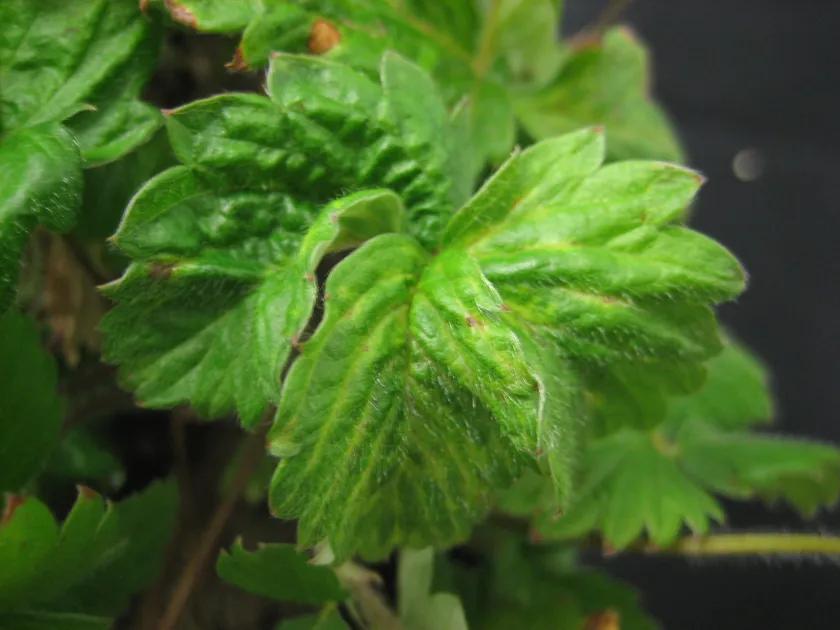
The main symptom of the disease is the presence of ring-shaped spots on the leaves, which often manifest as pale green or chlorotic patterns. The visibility of symptoms depends heavily on the plant variety and environmental conditions.
Infected plants often exhibit stunted growth and dwarfism. Shortened petioles give the plant a compact, flattened appearance, making it look sickly compared to healthy neighboring plants.
During the summer months, with rising temperatures, the characteristic rings on the leaves may disappear or become barely visible. This phenomenon of symptom masking makes field diagnosis quite difficult.
In susceptible strawberry varieties, leaf deformation is common. Leaves may become crinkled, with edges often curling upwards or downwards, which impairs photosynthetic efficiency and overall plant vitality.
Chronic infection leads to progressive reduction in fruit size. The berries lose their market value, ripening is delayed, and the total productivity of the plantation decreases significantly in the years following the initial infection.
Pathogen
The causative agent of the disease is the Stralarivirus fragariae (formerly known as Strawberry latent ringspot virus), belonging to the genus Stralarivirus. This is a soil-borne virus with a wide host range including both weeds and cultivated plants.
This pathogen is a polyphage, posing a significant risk to various agricultural crops. The virus is known to affect not only strawberries but also a variety of fruit trees, berry bushes, and vegetables.
The primary transmission vector in nature is soil nematodes of the family Longidoridae, particularly species of the genus Xiphinema. They acquire the virus while feeding on infected roots and can carry it for an extended period.
Another critical pathway for spread is the use of infected planting material. Because the virus can remain latent (asymptomatic) in the plant, seedlings are often the starting point for outbreaks in new fields.
The virus can also spread mechanically during routine agricultural practices if tools are not disinfected properly after contact with infected plant tissues.
Why it matters
The primary danger lies in the systemic nature of the infection. Once the virus enters the plant, it colonizes all tissues, making it impossible to cure with standard chemical treatments intended for fungal diseases.
Infected plantations quickly lose their economic viability due to a drastic drop in yields. Berries become small, taste profile decreases, and the plants eventually die off, creating patches of missing plants in the field.
The latent progression of the disease contributes to hidden spread. Growers may remain unaware of the problem until the plantation becomes entirely unproductive, necessitating a complete field replacement.
The virus significantly reduces the plant's winter hardiness. Affected plants are more likely to suffer from winterkill, leading to thinned stands and the need for early replanting.
Economic losses consist of direct yield reduction, costs associated with the premature removal of infected plantations, and the implementation of strict phytosanitary measures to prevent spread.
Protection
The foundation of control is the use of certified virus-free planting material. Sourcing seedlings from reputable nurseries is the only reliable way to prevent the introduction of the virus into your field.
It is crucial to monitor and control nematode populations in the soil, as they are the primary vectors. Before establishing a new plantation, testing the soil for these pests and performing fumigation if necessary is recommended.
When symptoms are identified, infected plants must be removed immediately, including their entire root system, and destroyed outside the field to prevent the virus from spreading further.
Maintaining spatial isolation from potential reservoirs, such as nearby weeds or infected orchards, is an essential preventative measure in the management of berry crops.
- Use only certified virus-free seedlings.
- Control soil-borne nematodes (vectors).
- Sanitize tools regularly to prevent mechanical transmission.
- Remove and destroy symptomatic plants promptly.
- Practice crop rotation with non-host crops to reduce virus levels.
Discussion
No discussions yet — be the first.