
Description
Symptoms
The most distinctive external symptom is the progressive yellowing and browning of older leaves, starting from the lower crown and moving upwards toward the younger fronds.
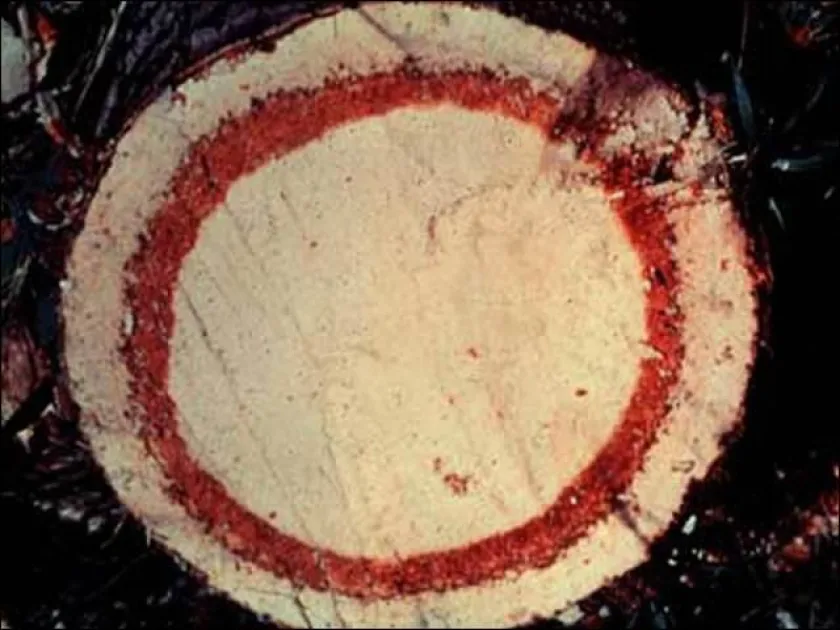
Cross-sections of the trunk reveal a characteristic dark red or chocolate-brown ring, typically 2–5 cm wide, located a few centimeters beneath the bark.
Affected palms show significantly stunted growth, and new leaves often appear thin, short, and malformed, losing their structural integrity.
Massive premature fruit drop is a common indicator of advanced infection, as the palm is no longer able to support the energy requirements of the developing nuts.
In later stages, the internal tissues of the trunk undergo decay, which can emit an unpleasant putrid odor due to the breakdown of plant fibers and bacterial colonization.
Pathogen
Red ring disease is caused by the nematode Bursaphelenchus cocophilus, a microscopic parasitic roundworm that attacks the vascular tissues of various palm species.
The disease is classified as a vascular wilt, where the parasite colonizes the stem, roots, and petioles, systematically disrupting the movement of water and nutrients.
The primary vector for the transmission of this nematode is the palm weevil, Rhynchophorus palmarum. Nematodes inhabit the weevil's body and are transferred to healthy palms during feeding or oviposition.
Once inside the plant, the nematode population grows rapidly, feeding on parenchyma cells and causing internal tissue necrosis.
This pathogen is considered a severe quarantine threat globally, as it is capable of devastating palm plantations in tropical and subtropical regions within a single growing season.
Conditions for development
The development of the disease is highly dependent on the presence of the palm weevil vector, whose population density determines the rate of spread.
Tropical climates with high humidity and consistent temperatures provide the optimal environment for both the reproduction of the nematode and the activity of the weevil vector.
Mechanical damage to the trunk, whether from agricultural tools or insect activity, facilitates the entry of the nematode into the succulent internal tissues of the palm.
The abandonment of diseased trees and improper disposal of organic waste create reservoirs of inoculum that sustain the life cycle of the pathogen and the insect vector.
Outbreaks are most prevalent in neglected or high-density plantations where sanitary practices are not strictly implemented, allowing the pathogen to persist and spread.
Why it matters
The disease primarily affects the coconut palm (Cocos nucifera), but it also poses a serious threat to other commercially important species like the oil palm (Elaeis guineensis).
Red ring disease is almost always fatal, as the systemic damage to the vascular system prevents the recovery of the tree once symptoms become visible.
Economic impact is massive, involving total loss of production and the high cost of eradicating and replacing entire palm stands to protect neighboring plantations.
The toxin produced by the nematode causes rapid wilting and necrosis, meaning that the physiological decline of the host is irreversible and swift.
Because there is no effective chemical cure for infected palms, the destruction of the industry in certain localized areas remains a significant risk.
Protection
Integrated pest management strategies focus on strict phytosanitary measures, including the mandatory prohibition of moving potential host materials from infected zones.
Immediate eradication of diseased palms is crucial; they must be felled, chopped, and burned to kill both the nematodes within the tissue and the weevils residing in the trunk.
Effective control of the palm weevil population using pheromone traps and localized insecticide applications is essential to reduce the transmission rate.
Regular surveillance and early detection are key to containing the disease, as removing a single symptomatic tree early can prevent the spread to adjacent palms.
Maintaining good plantation hygiene, including weed management and the prevention of stem damage, minimizes the risk of infection and promotes overall tree health.
Pathogens and affected parts
Affects crops · 1
Discussion
No discussions yet — be the first.