

Description
Symptoms
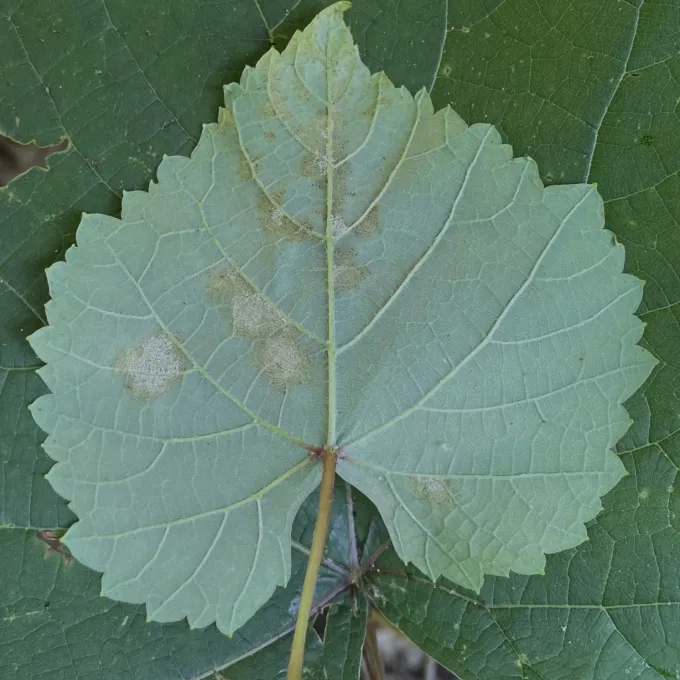
Initial symptoms on young leaves are known as "oil spots" — chlorotic, translucent yellow patches visible on the upper leaf surface.
Under humid conditions, a characteristic white, downy fungal growth appears on the underside of these spots, consisting of sporangiophores.
Infected inflorescences and young fruit clusters curl, turn brown, and eventually wither, leading to complete crop failure in severe cases.
Affected berries on older clusters may develop a gray appearance, harden, and become shriveled, often referred to as "leather rot".
Shoots and tendrils can also show signs of infection, characterized by thickened, stunted, and distorted growth with necrotic lesions.
Pathogen
The causal agent of downy mildew is Plasmopara viticola, an obligate oomycete pathogen that specifically targets the genus Vitis.
This pathogen acts as an internal parasite, colonizing the intercellular spaces of leaves, stems, and fruits, where it absorbs nutrients via haustoria.
Plasmopara viticola survives the winter in the form of oospores located within fallen infected leaves, which can remain dormant in the soil for several years.
The life cycle is highly dependent on environmental moisture, requiring films of water for the zoospores to swim and reach the stomata of the host plant.
It is a highly aggressive pathogen that can complete multiple infection cycles during a single growing season if weather conditions are favorable.
Conditions for development
Downy mildew development is triggered by the "ten-ten-ten" rule: temperatures above 10°C, shoot growth of at least 10 cm, and at least 10 mm of rainfall.
High humidity, frequent rain, and cloudy weather provide the necessary moisture for the rapid spread of zoospores throughout the vineyard.
Poor canopy management and excessive foliage density create high-humidity pockets that significantly increase the susceptibility of the vine to infection.
Nighttime temperatures and heavy dew formation are particularly conducive to the production and dispersal of sporangia on the lower leaf surface.
Conversely, hot, dry weather patterns effectively suppress the development and spread of the disease, forcing the pathogen into a latent state.
Why it matters
The disease causes premature defoliation, which severely limits the vine's ability to photosynthesize and ripen its woody tissue for winter.
Significant economic losses occur due to the direct destruction of flowers and berries, reducing total yield and quality of the final harvest.
Chronic infections weaken the overall vigor of the grapevine, making it more susceptible to winter frost damage and other opportunistic pathogens.
Fruit quality is degraded, as infected berries have lower sugar content and higher acidity, making them unsuitable for high-quality wine production.
Repeated annual outbreaks can lead to the decline and eventual death of the entire vineyard block if protective measures are neglected.
Protection
Effective control requires a combination of canopy management to improve airflow and targeted fungicide applications during critical growth stages.
Preventive measures include removing fallen leaves in autumn and maintaining proper vine training to minimize leaf wetness duration.
Copper-based fungicides remain a cornerstone for protective treatment, supplemented by systemic products during periods of rapid canopy growth.
Monitoring weather data and utilizing vineyard forecasting models helps in timing spray applications before infection conditions become critical.
- Planting resistant or tolerant grapevine cultivars.
- Balanced fertilization to promote strong shoot development.
- Regular pruning to facilitate air circulation and sun penetration.
- Rotating chemical modes of action to prevent pathogen resistance.
Content graph
Connections · Grape downy mildew
Most often together:
Marketplace
Products · 4


Community
Discussion
No discussions yet — be the first.