
Description
Symptoms
The most distinctive signs include the development of cankers on the branches and trunks. The bark in these areas becomes necrotic, cracks, and eventually peels away.
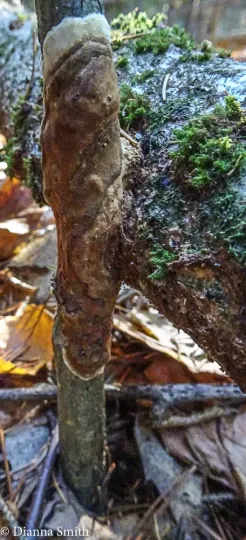
Fruiting bodies of the fungus appear as leathery, grayish-brown or ochre-colored crusts that tightly adhere to the surface of the bark at the infection site.
A specific sign of this condition is the "agglutination" effect, where fungal tissue forms a bridge, physically fusing infected branches to other healthy parts of the plant.
Leaves on infected branches often show early yellowing, wilting, and premature senescence, leading to a noticeable dieback of the tree canopy.
Upon removing the bark, internal wood discoloration, often appearing reddish-brown, is visible, indicating deep colonization by the fungal mycelium.
Pathogen
The causal agent of this disease is the fungus Hymenochaete agglutinans. It is a basidiomycete fungus known to cause bark necrosis and canker formation in various tree species.
The pathogen acts as a parasite, infecting the host through wounds, cracks in the bark, or natural openings, slowly colonizing the cambium and xylem tissues.
The fungus is biologically adapted to survive in humid conditions, which allows it to form thin, crust-like fruiting bodies directly on the infected bark surface.
A key biological feature of Hymenochaete agglutinans is its unique ability to cement branches together, which is the origin of its specific name agglutinans.
The fungus effectively disrupts the physiological functions of the tree, causing systemic weakness and structural damage to the bark and underlying wood tissues.
Conditions for development
The disease thrives in environments with high relative humidity and moderate temperatures, which are essential for spore germination and mycelial expansion.
Dense, poorly ventilated tree canopies provide an ideal microclimate for the pathogen, facilitating the infection process and the rapid spread of spores between limbs.
Infection is primarily spread by airborne spores, splashing raindrops, and insects that carry the fungal propagules to fresh wounds on host plants.
Trees like Liquidambar are particularly susceptible when planted in close proximity, allowing for direct contact between branches and easy transmission of the pathogen.
Periods of prolonged spring or autumn rainfall create the most dangerous windows for infection, as the moist bark surface is highly receptive to fungal colonization.
Why it matters
Hymenochaete cancer causes significant aesthetic and physiological damage, especially to ornamental trees, leading to limb dieback and structural instability.
By damaging the cambium, the fungus interferes with water and nutrient transport, which eventually results in the exhaustion and death of the entire tree.
The cankers serve as entry points for secondary pests and opportunistic pathogens, accelerating the decline of the plant and making recovery extremely difficult.
The economic impact is linked to the high costs of specialized pruning, tree removal, and the loss of long-term ornamental value in managed landscapes.
Untreated trees become reservoirs for the disease, posing a continuous threat to nearby healthy plants within nurseries and private gardens.
Protection
The primary control measure is rigorous sanitary pruning. All infected branches must be removed, including a portion of healthy wood to ensure complete eradication.
Tools used during the process must be disinfected after each cut to prevent the accidental transfer of spores to other trees in the collection.
Enhancing the overall tree health through balanced fertilization and proper irrigation helps build resistance and allows the tree to better withstand fungal pressure.
Any fresh wounds or pruning sites should be treated with fungicidal wood sealants to provide a protective barrier against fungal colonization.
In nurseries or high-risk areas, preventative application of broad-spectrum fungicides during the active growth period can help limit the spread of the disease.
Pathogens and affected parts
Affects crops · 1
Discussion
No discussions yet — be the first.