
Description
Symptoms
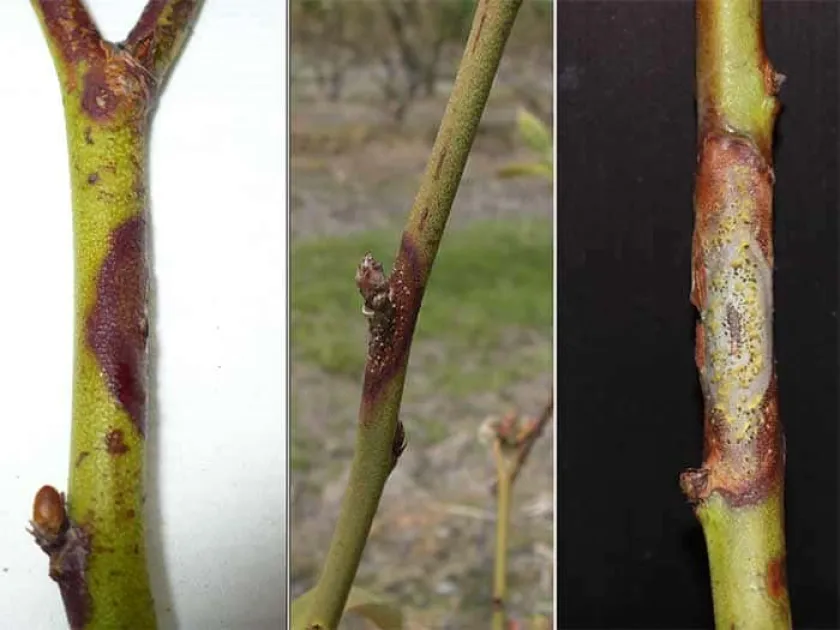
Early symptoms of the disease appear as small, reddish-brown circular spots on the stems of cranberry plants. Over time, these spots expand and develop into elliptical, sunken cankers.
As the infection progresses, the color of the cankered area transitions to a light gray or tan, often framed by a dark reddish-brown border. The bark in these areas eventually cracks and peels away.
During periods of high humidity, tiny black fruiting bodies called pycnidia develop on the surface of the cankers. These bodies release masses of conidia that contribute to further spread of the disease.
Infected stems often exhibit wilting and dieback of the growth above the canker site. Leaves on affected branches may turn yellow, redden, and drop prematurely as the plant's vascular system is compromised.
If a stem is sectioned, one can observe localized tissue necrosis and discoloration extending into the pith, which indicates a severe, established infection within the woody structure.
Pathogen
The causal agent of cranberry Godronia canker is the ascomycete fungus Godronia cassandrae (anamorph Fusicoccum putrefaciens). This pathogen is known to cause significant damage to members of the Vaccinium genus, primarily cranberries.
The fungus survives the winter as mycelium within the infected tissues of host plants. It produces asexual spores (conidia) in pycnidia and sexual spores (ascospores) in apothecia, which serve as primary sources of infection during the growing season.
Pathogen entry occurs through various mechanical wounds, pruning cuts, or natural openings like leaf scars. Once inside, the fungus colonizes the cortex and phloem, eventually spreading into the xylem tissue.
Environmental conditions play a crucial role in the lifecycle of the pathogen. Spore dispersal is highly dependent on rainfall, with splashing water carrying conidia to healthy plant parts.
Because the fungus is adapted to acidic, water-logged conditions typical of cranberry bogs, it can remain active and infectious across a wide range of temperate climates.
Conditions for development
Godronia canker thrives in conditions of high humidity and prolonged moisture. Bog environments with poor drainage provide the ideal setting for the pathogen to flourish.
The disease development is heavily influenced by temperature. Optimal growth for Godronia cassandrae occurs at temperatures ranging from 15°C to 22°C, which are common during spring and autumn.
Plants under physiological stress, particularly those damaged by winter frost or insect feeding, are significantly more susceptible to pathogen entry and subsequent colonization.
Poor ventilation within dense canopy foliage traps moisture, creating a microclimate that prevents stems from drying out and promotes the germination of fungal spores.
Imbalanced fertilization, particularly an excess of nitrogen, promotes lush, succulent growth that is physically softer and more prone to penetration by the fungal mycelium.
Why it matters
Godronia canker is a major economic threat to cranberry production. It directly reduces the vigor of the vines and leads to significant yield losses due to branch death.
Infected vines lose their hardiness, making them highly vulnerable to winter injury and frost kill, which leads to thinning of the stands and reduced plantation lifespan.
The disease spreads rapidly across a field if left unmanaged. Over several years, untreated infections can decimate an entire crop and make the site unfit for commercial production.
The pathogen’s ability to persist in plant debris and the surrounding environment makes complete eradication difficult, necessitating long-term management strategies.
Additional costs incurred by growers for fungicide applications and labor-intensive sanitation practices further impact the overall profitability of the cranberry operation.
Protection
Effective management begins with the use of certified, disease-free planting stock. Ensuring that new installations are clean is the most important step in preventing the introduction of the fungus.
Sanitation is critical; growers must prune out and remove infected stems as soon as they are identified. Infected material should be burned or buried to minimize the spore load.
Improving bog water management and drainage is essential to reduce the humidity levels around the vines, which inhibits the conditions required for fungal spread.
Chemical control programs involving the strategic application of protective fungicides can help manage the disease, especially during the early spring and post-harvest growth stages.
- Regular monitoring of stem health during the season.
- Optimizing nitrogen application to prevent excessive succulent growth.
- Using fungicides registered for Godronia control.
- Maintaining proper spacing to ensure airflow.
Pathogens and affected parts
Affects crops · 1
Discussion
No discussions yet — be the first.