
Description
Symptoms
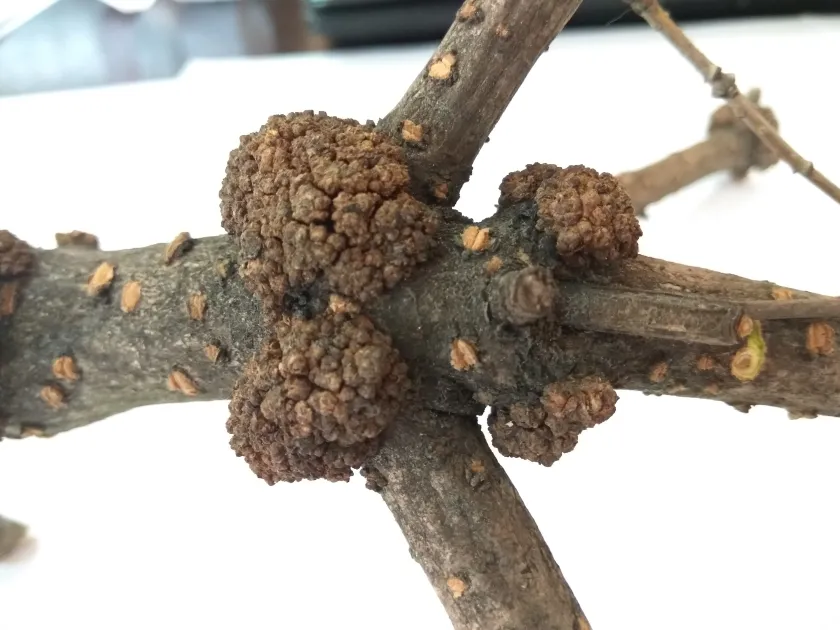
The hallmark of crown gall is the development of abnormal outgrowths or galls on the roots, crown, or lower stems of infected plants.
Initially, these galls appear as soft, light-colored, and spongy lumps that are difficult to distinguish from normal callus tissue.
Over time, the galls enlarge, darken to a brown or black color, and become hardened, woody, and cracked due to the rapid growth of infected cells.
In raspberry crops, infected plants often exhibit stunted growth, chlorotic leaves, and a general decline in vigor, which is especially noticeable during dry spells.
Advanced infections can lead to the complete decay of the root system, causing the plant to collapse and eventually perish due to nutrient starvation.
Pathogen
The causative agent of this disease is a group of soil-borne phytopathogenic bacteria known as Agrobacterium, primarily the species Agrobacterium tumefaciens.
These bacteria possess a unique mechanism involving the transfer of a specific segment of their DNA, known as T-DNA, into the host plant's genome.
Once the bacterial DNA is integrated, it forces the plant cells to produce opines and growth hormones, leading to uncontrolled cell division.
The pathogen is highly persistent, capable of surviving in the soil and on infected plant debris for many years without a host.
Transmission occurs primarily through nursery stock, contaminated tools, and irrigation water that carries bacterial cells into healthy soil.
Conditions for development
The infection process requires a pathway for the bacteria, which is typically provided by mechanical wounds on roots or stems.
These wounds are often created during transplanting, grafting, pruning, or by the feeding activity of soil insects such as nematodes or beetle larvae.
The bacteria thrive in moist, neutral to slightly alkaline soil environments, which favor their mobility and colonization of host roots.
High-density planting increases the likelihood of cross-contamination, as roots of adjacent plants may touch and spread the bacterial population.
The presence of moisture in the soil is critical for the bacteria to navigate towards the wounded plant tissue through chemotaxis.
Why it matters
The galls act as a biological sink, diverting essential sugars and minerals from the plant, which results in significant energy loss.
Systemic interference with vascular tissues disrupts the transport of water and nutrients, making the plant highly vulnerable to environmental stress.
Reduced vigor and yield are the most common consequences, with fruits often appearing small, discolored, or of inferior quality.
In nurseries, the presence of crown gall can lead to entire batches of seedlings being discarded, causing significant financial losses.
Because there is no cure once a plant is infected, the long-term impact on soil health requires strict management to prevent further spread.
Protection
Strict sanitation and the use of certified, disease-free nursery stock are the most effective methods for controlling the spread of crown gall.
Avoid planting susceptible crops, such as raspberries and fruit trees, in soil known to have a history of the disease for at least several years.
Ensure that all pruning tools are sterilized with appropriate disinfectants after every use to prevent the transmission of bacteria between plants.
Infected plants must be immediately removed, including the root system, and destroyed by burning to minimize the bacterial load in the soil.
Biological control agents, such as specific non-pathogenic strains of Agrobacterium, can be applied to planting material to compete with and exclude the pathogen.
Pathogens and affected parts
Affects crops · 1
Discussion
No discussions yet — be the first.